Crypto Market Trend Indicators: Master Signals for 2026
Master crypto market trend indicators. Learn traditional vs. on-chain signals, how to combine them, and use tools like Wallet Finder.ai for smart decisions in

June 5, 2026
Wallet Finder

June 5, 2026

You're probably looking at a chart that seems obvious for a moment, then completely ambiguous a few candles later. Price pushes up, RSI looks stretched, MACD starts to turn, and a few large wallets begin moving size on-chain. The problem isn't a lack of signals. It's figuring out which ones describe a real trend and which ones are just noise dressed up as conviction.
That's where market trend indicators help, but only if you use them for their intended strengths. In crypto, a clean edge rarely comes from one line on a chart. It comes from combining traditional technical indicators, which summarize price behavior, with on-chain indicators, which show what market participants are doing with capital in real time.
A trend can look clean until the next few candles print. Bitcoin grinds higher, altcoins lag, funding starts to heat up, and one wallet cluster begins sending size to exchanges. In that moment, a single chart indicator is usually too narrow. Market trend indicators matter because they help separate a durable move from a move that only looks strong on the surface.
At a basic level, market trend indicators are tools for organizing market behavior into something tradable. They help answer a narrower and more useful question than “where does price go next?” The better question is whether the current move has direction, strength, participation, and enough follow-through to justify risk.
The first family is traditional technical indicators. These are built from price and volume on the chart. Moving averages smooth trend direction. RSI tracks the pace of recent moves. MACD compares short-term and medium-term momentum. ADX measures whether a market is trending with enough force to matter. If you want a more detailed breakdown of speed and exhaustion signals, this guide to momentum indicators in crypto trading covers that layer well.
The second family is on-chain indicators. These start with blockchain activity instead of candle structure. They track wallet accumulation, exchange inflows and outflows, holder behavior, realized profit-taking, and capital rotation across assets. In crypto, that changes the job of trend analysis. Traders are no longer limited to reading the result of positioning. They can also inspect parts of the positioning itself.
Practical rule: Chart indicators show how the move looks. On-chain indicators help show who is behind it, and whether that participation is expanding or fading.
Used correctly, trend indicators help traders judge four things:
That last point gets overlooked. Traders often blame an indicator when the underlying problem is regime mismatch. A moving average crossover can work well in expansion and fail repeatedly in sideways conditions. On-chain signals have the same limitation. Wallet accumulation can appear constructive for days while price stays range-bound because macro pressure or derivatives positioning keeps capping the move.
The edge comes from combining both sets of information. Traditional indicators are usually lagging. They confirm that a move is already visible in price. On-chain indicators can be earlier, but they are noisier and easier to misread without context. A useful framework is simple: use chart-based indicators to confirm structure, then use on-chain activity to test whether the trend has real sponsorship behind it.
That is the standard I use. The question is rarely “Which indicator is best?” It is “Which mix of lagging confirmation and leading participation gives a signal worth betting on?”
Most traders start with chart indicators because they're visible, accessible, and fast to apply. That's fine. The mistake is stopping there.
Traditional indicators are useful because they convert raw price action into readable patterns. Modern trend analysis is widely described as a statistical technique that identifies patterns over time using methods such as moving averages, exponential smoothing, decomposition, clustering, and ARIMA models, as outlined in NetSuite's overview of trend analysis. In practice, traders mostly interact with the simpler layer of that toolkit.
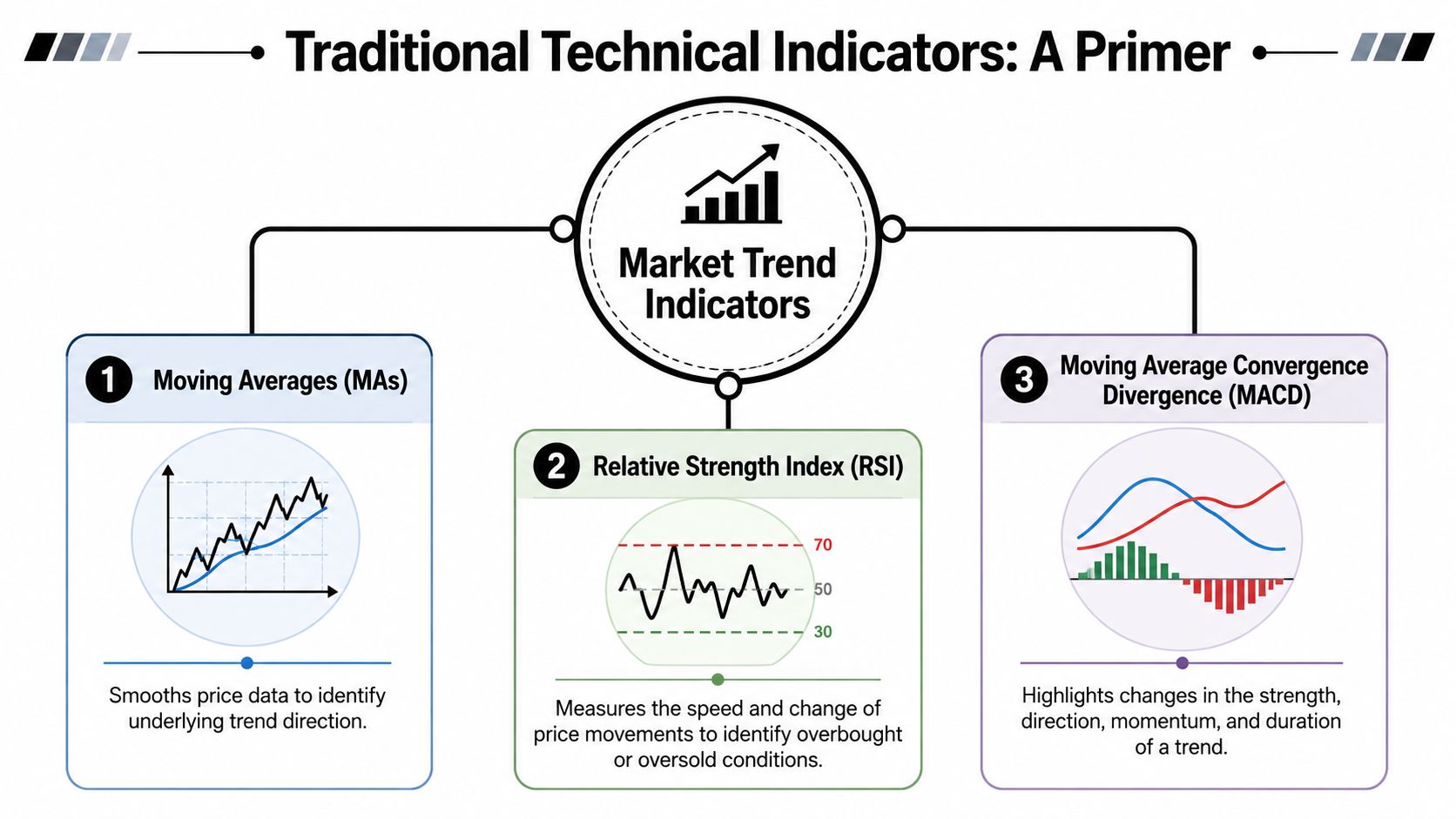
Before adding anything to a chart, check the sequence of highs and lows. A true uptrend is defined by higher highs and higher lows, while a downtrend shows lower highs and lower lows. Trend lines need at least two qualifying pivots and then act as dynamic support or resistance until broken, according to Fidelity's explanation of trend structure.
That's the base layer. Indicators should confirm structure, not replace it.
Here's the quick read on the classic set:
If you want a deeper read on momentum tools specifically, this guide on crypto momentum indicators is a good companion.
The strongest charts usually look simple before they look impressive.
Traditional indicators earn their place because they create discipline. They help you avoid reacting to every wick and force you to ask whether the move is still aligned with trend direction.
But they all share the same weakness. They're built from historical price. That means they lag.
A moving average crossover can confirm that a move is underway, but it won't tell you whether smart money is accumulating before the crowd notices. RSI can tell you a move is stretched, but it can't tell you whether exchange balances are tightening or whether large profitable wallets are stepping in. MACD can improve timing, but it still reads what price has already done.
That lag doesn't make technical indicators bad. It just means they work best when paired with a second layer of evidence.
Traditional indicators look at the shadow on the wall. On-chain analysis looks at the object casting it.
In crypto, that difference matters because the market is transparent in a way equities and FX usually aren't. You can often see wallets accumulating, rotating, distributing, or moving assets to exchanges before the broader market fully prices in the implications.

The main advantage of on-chain signals is participation visibility. A rising price trend can be low quality if it isn't backed by sustained participation, which is why newer trader education increasingly emphasizes market structure confirmation and on-chain activity in crypto markets, as described in Angel One's discussion of trend indicators and participation.
That's the key shift. You're no longer asking only whether price is going up. You're asking whether market participants are behaving in a way that supports continuation.
Useful on-chain categories include:
For a practical foundation, this explainer on crypto on-chain analysis is worth reading.
On-chain data feels more “real” because it reflects actual transactions, but it has blind spots too. Not every transfer is directional. Not every whale is smart. Some activity is internal routing, treasury movement, bridging, or liquidity management.
That's why context matters. A single wallet buy means little on its own. A cluster of profitable wallets accumulating while price reclaims trend structure means much more.
A short walkthrough helps clarify how to think about that mix:
The cleaner crypto setups tend to have three traits at once:
When one of those is missing, the move often becomes unstable. You'll still see pumps. You just won't see many that hold.
That's the edge on-chain gives you. Not certainty. Better context.
A token breaks above resistance, MACD turns up, and the first candle looks clean. Traders chase it. Two hours later, the move stalls because the chart improved before real participation showed up.
That is the core problem with single-indicator trading. One tool can show better timing or cleaner structure, but it rarely answers whether the move has enough sponsorship to continue.
The higher-quality setup is a stacked one. Traditional indicators help define trend, momentum, and entry location. On-chain signals test whether actual capital is supporting that trend or merely rotating through it for a quick move.
I use a four-step filter:
Order matters.
If the chart is messy, on-chain confirmation usually does not save the trade. If the chart looks strong but wallet participation is absent, the move can still work, but it tends to be less stable and harder to hold through volatility.
| Attribute | Traditional Indicators | On-Chain Indicators |
|---|---|---|
| Primary input | Price, volume, chart history | Wallet activity, transfers, holdings, exchange flows |
| Main strength | Clear trend visualization and timing structure | Visibility into participant behavior as it develops |
| Main weakness | Lagging by design | Easy to misread without context |
| Best use | Defining direction, regime, and trade location | Testing whether the move has real conviction |
| Typical failure mode | Whipsaws in chop | Treating treasury moves, routing, or exchange deposits as bullish |
| Strongest setup | Confirms structure and momentum | Confirms accumulation, rotation, or distribution |
The trade-off is straightforward. Technicals are better for execution. On-chain is better for validation. Using both gives a cleaner read than forcing either one to do the other's job.
A stronger long setup usually has independent confirmation across different dimensions:
That is real confluence. It is not a stack of five indicators built from the same price series.
Many traders make that mistake. RSI, MACD, stochastic, and moving average crossovers can all point the same way because they are all reacting to the same recent candles. Add on-chain behavior and you finally introduce a different class of evidence.
A useful rule is simple. Let technicals answer, "Is this worth trading at all?" Let on-chain answer, "Does this move have credible backing?" Traders who want a more systematic version of that process can use this framework for data-driven trading workflows.
Theory is easy to agree with. The harder part is turning it into something you can repeat under pressure.
The workflow below is designed for crypto traders who want a short decision loop instead of a sprawling research process. It starts on the chart, then moves to wallet behavior, then narrows down to execution candidates.
Begin with price structure and trend strength. MACD is computed as the 12-period EMA minus the 26-period EMA, with a 9-period EMA of MACD used as the signal line, while ADX measures trend strength on a 0 to 100 scale. A practical approach is to require directional evidence from MACD and enough ADX strength before acting, as described in TradingSim's explanation of MACD and ADX.
That gives you a filter for “interesting” versus “tradable.”
Once a token passes the chart test, check whether on-chain activity supports the move. For this, Wallet Finder.ai can be useful because it surfaces wallet behavior, token activity, and trade histories in one place.

What to look for:
After validating the token, move one level deeper. Look for wallets that have shown consistent timing in that asset or sector.
A useful review process is:
Many traders improve. This occurs when they stop treating all whale activity as equal.
If a token looks strong but the best wallets are distributing into strength, the chart is often late.
The last step is operational. Add the relevant wallets and tokens to a watchlist, then use alerts so you're not manually refreshing dashboards all day.
A tight workflow usually looks like this:
This process won't remove uncertainty. Nothing will. But it does stop you from acting on isolated chart signals with no evidence of real sponsorship.
A trader sees a clean moving average crossover after a sharp green push, enters late, then watches the move stall as early wallets sell into strength. The indicator did its job. The trader misread what kind of signal it was.
Most indicator losses come from using the right tool in the wrong context. In crypto, that usually means treating lagging chart signals as if they were early warnings, or treating on-chain activity as if every wallet transfer carries the same weight.

These errors usually cluster together. A trader loses confidence in one signal, adds more filters, then starts adjusting every input until the model looks precise in hindsight and useless in live trading.
Trend indicators work very differently in expansion than they do in chop. A moving average crossover during a clean directional move can help keep a trader positioned. The same crossover inside a range is often just noise with a delay built in.
Some traders use ADX to separate stronger trends from weak directional drift. LightningChart's discussion of trend regime and ADX notes the common view that readings above 25 often point to stronger trend conditions. That is useful context, not a free pass to trade every breakout.
A better habit is to ask a few blunt questions before trusting any signal:
If those answers are unclear, indicator precision will not save the trade.
The fix is usually subtraction, not addition. Use traditional indicators for structure and momentum. Use on-chain data for participation and timing. Do not ask one tool to do all three.
| Question | Better focus |
|---|---|
| Is the market trending? | Price structure and trend strength |
| Is momentum improving? | MACD or moving average behavior |
| Is participation real? | Wallet activity and flow quality |
| Is this setup strong enough to trade? | Alignment across all three |
That last row matters most. A clean chart with weak wallet sponsorship is often late. Heavy wallet activity with poor structure can stay dead money longer than expected.
Indicators should filter trades, not manufacture conviction.
As traders improve, charts usually get simpler. The framework gets stricter. The edge comes from combining lagging confirmation with leading on-chain context, then respecting the limits of both.
Market trend indicators matter, but not for the reason most traders think. Their job isn't to predict the future perfectly. Their job is to help you organize uncertainty into a process you can repeat.
That process works better in crypto when you split responsibilities. Let traditional indicators define direction, structure, and momentum. Let on-chain analysis test whether the move has real participation behind it. When both agree, the signal usually gets more durable. When they diverge, caution usually pays.
This is also where many traders grow out of beginner habits. They stop chasing isolated crossovers. They stop treating every green candle as trend confirmation. They start asking better questions about quality, regime, and sponsor behavior.
The strongest edge usually isn't a secret indicator. It's a framework that filters weak setups before capital gets committed.
Used that way, market trend indicators become much more than chart decorations. They become a trading checklist. One layer reads the tape. The other reads the actors behind it. That combination is far more useful than either side on its own.
If you want to apply that workflow with live wallet activity, Wallet Finder.ai lets you track profitable wallets, monitor token flows, build watchlists, and receive alerts when tracked wallets buy or sell, so you can validate chart trends against actual on-chain behavior before taking a trade.