Crypto Market Trend Indicators: Master Signals for 2026
Master crypto market trend indicators. Learn traditional vs. on-chain signals, how to combine them, and use tools like Wallet Finder.ai for smart decisions in

June 5, 2026
Wallet Finder

June 5, 2026

More than 300,000 scam tokens have been created, and 8% of all Ethereum ERC-20 tokens plus 12% of all Binance Smart Chain BEP-20 tokens were designed as rug pulls, according to Solidus Labs on crypto rug pull scams. That changes how you should think about risk in DeFi. The danger isn't limited to a few obviously fake projects. It sits inside the normal flow of token launches, hype cycles, and fast-moving social narratives.
A lot of new traders think getting rug pulled out means they picked a bad chart. Sometimes that's true. Sometimes a token just fails. But a real rug pull has a different shape. Someone controls the setup, attracts your capital, and then removes the support that made the market look tradable in the first place.
If you trade memecoins, low-cap DeFi tokens, or fresh launches on a DEX, you need a sharper filter than “the website looks legit” or “people on X seem excited.” You need to read the structure underneath the story.
The phrase comes from the older idiom “pull the rug out from under,” which means to suddenly remove important support, security, or stability from someone, leaving them in a difficult position, as defined by Cambridge Dictionary's entry on pull the rug out from under. That original meaning maps perfectly onto crypto.
In normal life, the “rug” might be trust, a contract, or a promise you were relying on. In DeFi, the rug is often liquidity, sellability, or the belief that the people behind a token are still building. Once that support vanishes, the chart doesn't drift lower in an orderly way. It collapses.
A common beginner mistake is thinking a rug pull always looks theatrical. It often doesn't. The chart can look healthy for hours or days. Buys keep coming in. The Telegram is active. The team posts memes, roadmap updates, and vague partnership hints. Then one wallet moves, liquidity disappears, sells stop working, or insiders dump at once.
Practical rule: If a token depends on one group's continued good behavior, you're not just trading price. You're trading trust.
That's why “rug pulled out” is such a useful phrase. It captures the feeling traders describe after the event. One minute, there seems to be a floor under the market. The next minute, there isn't.
A new trader sees a token trending, notices quick upside, and enters after a few green candles. The position goes positive. Confidence rises. Then the pool gets drained or the token becomes impossible to sell. The profit on screen turns into a wallet full of something nobody can exit.
That isn't ordinary volatility. It's a support structure being removed.
People often ask whether every violent crash is a rug pull. No. Some launches are sloppy, overhyped, or badly structured. Some teams migrate liquidity. Some whales dump. The hard part is telling the difference before the collapse becomes obvious.
That distinction matters because your defense isn't emotional. It's forensic. You need to inspect who controls the token, who controls the liquidity, and whether the contract lets the team change the rules after you buy.
In crypto, a rug pull is when developers abandon a project and take investor assets, and Bankrate distinguishes between hard rug pulls and soft rug pulls in its explainer on what a rug pull is in crypto. That distinction matters because the warning signs differ.
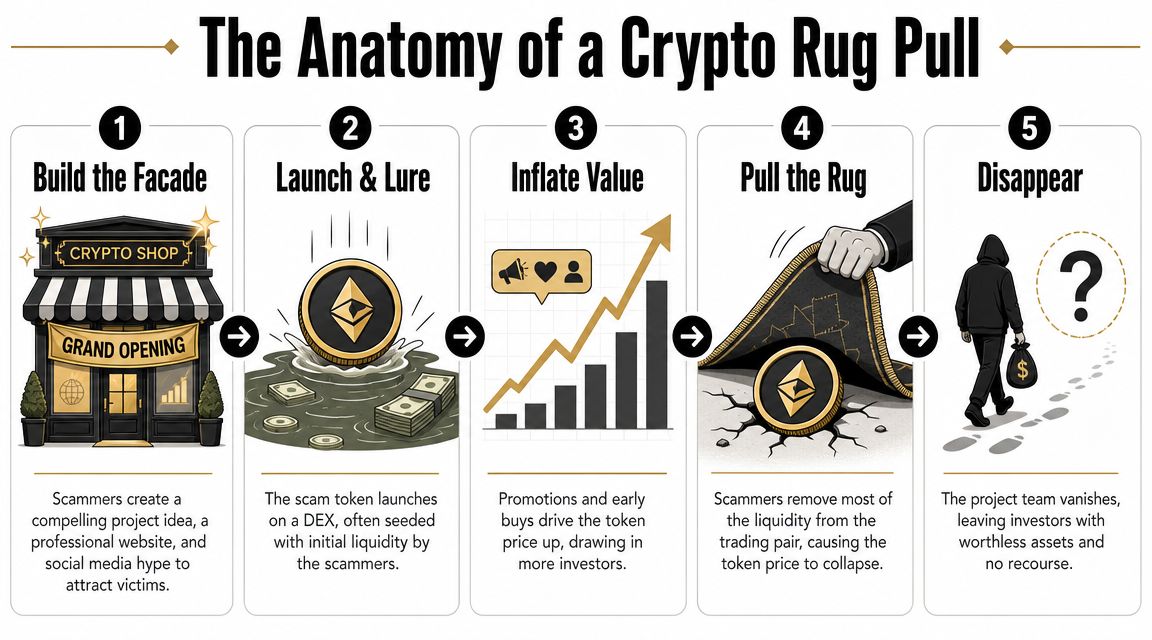
Think of the scam like a polished storefront built around an empty shop. The signs look clean. The branding feels current. A line forms outside. But the owners never intended to run a real business. They just needed enough people to walk in with money.
Most rug pulls follow a recognizable rhythm:
A token gets created.
The team deploys a contract and sets supply rules, wallet permissions, and trading behavior.
Liquidity appears on a DEX.
This creates the appearance of a live market. Traders now see a pair and a chart.
Promotion starts.
Social accounts push the story. Communities form fast. Early buys create momentum.
Price rises.
New traders interpret the climb as validation. Momentum itself becomes marketing.
Control gets used against holders.
The team drains liquidity, dumps tokens, disables selling, or disappears after extracting value.
A hard rug pull has theft built into the structure from the start. The contract may include malicious permissions, hidden mint functions, blacklist logic, or sell restrictions. In plain terms, the trap is in the code.
These are the most dangerous for beginners because the chart can look normal right up until the contract behavior gets weaponized. If the owner can change fees, block addresses, mint supply, or alter transfer rules, the market isn't really open. It's conditional.
A soft rug pull depends less on code and more on human behavior. The team hypes the project, accumulates attention, then dumps large holdings or abandons the community once enough outside buyers have arrived.
This kind of rug can fool traders who only check whether swaps are working. The token may be technically sellable. The problem is that the insiders were always planning to exit into community demand.
A token can be tradeable and still be a trap if insiders control too much supply and the project has no intention of lasting.
If you're studying wallets, a hard rug often shows up through contract permissions and weird trade behavior. A soft rug often shows up through concentrated insider holdings, aggressive promotion, and exits from wallets linked to the deployer or early funding trail.
Different mechanism. Same ending. Holders are left with an asset whose market support was never durable.
Rug pulls happen at industrial scale. As noted earlier, analysts have documented hundreds of thousands of scam tokens and millions of affected investors. That volume matters because it changes the right mental model. You are not evaluating a rare mistake. You are entering a market where some teams launch tokens the way spammers launch domains, fast, repeatable, and built to exploit attention before scrutiny catches up.
The trap usually starts before the contract gets examined. It starts with a story.
A scam token often arrives wrapped in the signals traders associate with legitimacy. The website looks polished. The roadmap has phases, mascots, and token allocation charts. Social accounts post around the clock. Paid callers and small influencers create the impression that discovery is already underway. To a new trader, that can feel like early momentum. To an on-chain analyst, it raises a different question: who is creating the appearance of demand, and are wallets confirming that story?
Scammers sell confidence first because confidence buys them time. If enough people believe a launch is "hot," fewer of them stop to inspect who funded the deployer wallet, who received the earliest token allocations, or whether the liquidity can disappear on command.
Common packaging signals include:
That last tactic is especially effective. Urgency shortens analysis. Shortened analysis is where bad trades happen.
Social proof in crypto is cheap to manufacture. A token can look popular long before it has any real holder base. Bot replies, copied comments, fake partnership hints, and recycled memes can create the feeling that a crowd has already done the homework.
Treat that like stage lighting. It can make the set look bigger than it is.
The practical check is simple. If the social story sounds strong, the on-chain picture should look strong too. Wallet activity should show more than a few related addresses passing tokens around. Funding should not trace back to a tight cluster with obvious links. Early buys should not be dominated by wallets that appear coordinated. When the marketing is loud and the chain is thin, the promotion is often the product.
If the story says "community," but the wallets say "cluster," trust the wallets.
Scam operators know traders have learned one defensive habit: ask whether the contract was audited. So they prepare an answer in advance. Sometimes it is a badge on the homepage. Sometimes it is a screenshot. Sometimes it is a promise that an audit is coming soon.
None of those signals proves the contract is safe.
A real review process produces something you can verify, scope you can inspect, and findings you can question. Surface-level security branding does not do that. If you want a better frame for judging those claims, this guide to smart contract security audit services explains what a serious review should cover and what marketing language leaves out.
The final piece is psychological. Scam teams want to compress the time between discovery and purchase. They do not need you to understand the token. They need you to buy before you check the parts of the market structure that can be weaponized.
That is why many traps feel exciting right up until they fail. The setup is built to keep your eyes on price, social buzz, and launch energy while risk sits elsewhere, in wallet concentration, contract permissions, funding trails, and liquidity control. A trader who learns to read those signals early is much harder to trap.
The hardest part isn't learning the definition. It's distinguishing a coordinated rug from normal volatility by reading on-chain and social signals before the damage is obvious. That challenge matters because scam creators have launched hundreds of thousands of fake tokens with different mechanisms, as noted in Dictionary.com's discussion of the phrase and its crypto extension.

A useful mindset is this: don't ask “Can this token go up?” first. Ask “Who can break this market?”
Most rug pulls become possible because one actor, or a small cluster of related wallets, controls something critical. That could be liquidity, contract permissions, treasury supply, or the largest holder cluster.
Check these first:
Liquidity status
If liquidity isn't locked or otherwise credibly constrained, the team may be able to remove the trading support that makes the market function.
Owner permissions
If the contract owner still has authority to change fees, mint tokens, pause transfers, or blacklist wallets, you need to treat the token as mutable.
Holder concentration
A token can look distributed while a handful of linked wallets discreetly control most of the actionable supply.
Some scams don't drain liquidity immediately. They block exits. These contracts are commonly called honeypots because buying works while selling fails or becomes economically impossible.
Warning signs include:
If you need a deeper walkthrough on this specific trap, a honeypot scanner guide for crypto traders is worth reviewing before you touch fresh tokens.
Field note: A token that lets the team change trade behavior after launch isn't finished code. It's a live weapon pointed at holders.
Transaction flow often tells you more than the homepage. Look for:
The question isn't whether big wallets exist. The question is whether those wallets look independent.
| Red Flag | What It Means | How to Check |
|---|---|---|
| Unlocked liquidity | The team may be able to withdraw support from the trading pair | Review the token pair on the DEX and inspect whether LP tokens appear controlled by the deployer or related wallets |
| Concentrated top holders | A few wallets may be able to dump price or simulate decentralization | Open the holders tab on a block explorer or token tracker and study wallet clustering |
| Active owner permissions | The contract may still allow rule changes after launch | Read the contract functions and ownership status on the block explorer |
| Suspicious wallet flows | Funding, distribution, or exits may be coordinated behind multiple addresses | Follow wallet transfers from deployer, treasury, and earliest buyers |
| Sell restrictions or honeypot behavior | You may be able to buy but not exit normally | Test trade behavior cautiously and inspect contract logic with scanner tools |
| No credible audit evidence | Important risks may be unreviewed or hidden behind marketing claims | Verify whether an actual audit report exists and whether it matches the deployed contract |
| Renounced ownership claims that don't match reality | The team may still control key mechanics despite public statements | Compare public claims against the contract's current privileges on-chain |
A single red flag doesn't prove a rug. But several weak signals lining up should stop you from entering. New traders usually focus on chart shape because it's visible. Experienced traders focus on control because that's where the risk lives.
Manual checks are necessary, but they're slow. Rug pulls often unfold faster than a human can keep up if you're watching multiple chains and new launches at once. Real protection comes from turning your checklist into an active monitoring process.

A token page tells you what happened. Wallet monitoring often tells you who's doing it.
When you're researching a new launch, track:
If those wallets begin transferring funds out, splitting balances across new addresses, or selling in sync, you have a stronger signal than a red candle alone. Wallet behavior often exposes intent before the public narrative changes.
A simple process works better than a complicated one you won't maintain.
Identify the token and deployer trail
Start from the contract and map the first few funding relationships.
Review the holder map
Separate obvious contract addresses from likely human-controlled wallets.
Flag wallets that matter
Deployer, treasury, LP controller, early whales, and wallets receiving unusual allocations.
Set alerts on movement
Watch for liquidity removals, large transfers to exchanges or routers, and coordinated exits.
Re-check after marketing spikes
A project often behaves differently once outside demand arrives.
Specialist analytics platforms can help. Instead of checking one block explorer tab at a time, traders often use wallet intelligence tools to compare histories, identify repeat behavior, and watch meaningful addresses in real time. For a broader survey of that stack, this review of the best DeFi analytics tools for crypto traders is a practical place to start.
Good monitoring doesn't predict every scam. It shortens the time between the first suspicious move and your decision to stay out.
If you're new, don't try to alert on everything. Start with the events that most often precede trouble:
Liquidity-related movement
If wallets tied to LP control begin moving assets, pay attention immediately.
Top-holder redistribution
A whale splitting supply into multiple addresses can be preparation, not decentralization.
Sudden changes in contract interaction
New admin actions, toggles, or unusual function calls deserve scrutiny.
Synchronized wallet selling
Multiple early wallets exiting together often says more than social sentiment ever will.
In slow markets, you can study a token for days. In memecoin and launch-driven markets, the setup can form and unwind in a short window. Real-time detection helps you avoid entering after insiders have already positioned themselves for the exit.
That alone can save you from the classic beginner error: buying the story after the operators have already written the ending.
Rug pulls still hit traders hard. Binance's glossary, citing CertiK, said rug pulls caused $85.4 million in losses in 2024 alone, and memecoin-related rug pulls and scams added far more damage on top of that. Those numbers matter for one reason. This is not an edge case from the last cycle. It is an active threat in the current crypto market.

Well-known rug pulls are useful study material because they show how collapse usually looks from the inside. Traders often experience it as a sudden drop, like a floor disappearing under their feet. On-chain, the setup is usually more like a staged bank run. Control sits with a small group, liquidity is fragile, and one coordinated move turns a lively market into a dead chart.
The headline varies, but the mechanics repeat.
Some projects used sell restrictions or hostile token logic. Buying worked. Selling later became difficult, heavily taxed, or impossible under certain conditions. Others ran the more familiar hype-then-exit playbook. A strong meme, aggressive promotion, and fast early price action pulled in outside buyers while insiders prepared their way out.
The common mistake was not just greed. It was attention drift. Traders watched the story, while the contract and wallet structure told the more useful story. A token can look popular and still be one admin function away from disaster.
That is why strong post-mortems focus less on drama and more on sequence. Who funded the deployer. Who received supply early. When liquidity changed. Which wallets sold first. If you are using a tool like Wallet Finder.ai, that is the right frame. The goal is not to admire the wreckage after the fact. The goal is to spot the setup while the crowd still sees momentum.
Rug pulls rarely become clear at the exact moment they begin. They become clear after the key wallets act.
The following video breaks down how these scams are explained and how traders react once a collapse happens.
After the collapse, the social layer usually breaks first. Team accounts stop posting, moderators vanish, or the project shifts into excuses about bots, market makers, or “community panic.” Holders start comparing transaction hashes because the price chart alone no longer explains what happened.
On-chain, the footprint is more concrete:
For analysts, these cases are training reps. You learn to read the order of operations, not just the final candle. For traders, the practical lesson is simple. By the time the community agrees a rug pull happened, the useful decision point was usually hours or days earlier.
First, accept the situation clearly. If the team drained liquidity, blocked exits, or vanished after a coordinated dump, your priority is damage control, not hope. Hoping the community “revives” a compromised token usually wastes time you should spend securing the rest of your wallet.
Take these steps in order:
Stop interacting with the token
Don't keep approving contracts, chasing recovery tools, or connecting your wallet to random “claim” pages.
Revoke token permissions
Review active approvals and remove any that are no longer needed. That reduces the chance of further loss through lingering contract access.
Document everything
Save the contract address, transaction hashes, screenshots of project claims, and wallet movements you can still view.
Warn others where the token was promoted
Post factual information in the project's channels and on social platforms. Stick to verifiable details.
Report the scam
File reports with the relevant exchange, chain ecosystem contacts, or law enforcement channels available in your jurisdiction.
The worst response is pretending it was pure bad luck. A rug pull usually leaves a pattern behind. Study what you missed. Was it unsecured liquidity, owner control, fake social proof, clustered holders, or suspicious wallet funding?
That review matters because DeFi rewards traders who get faster at saying no.
If you want a cleaner way to watch wallet behavior before a collapse becomes obvious, Wallet Finder.ai helps traders track smart money movements, investigate holder activity, and monitor on-chain flows in real time. Used well, it can make your due diligence more proactive and less dependent on hype.