
Guide to Security Audit Networks for DeFi Traders
Master DeFi with our guide to security audit networks. Learn to analyze reports, spot red flags, and protect your crypto portfolio from hidden risks.
A security audit network isn't a single company; it's an ecosystem of experts, tools, and processes working together to ensure a DeFi project is safe. Think of it as a multi-layered inspection team giving a protocol's digital foundation a thorough shakedown before anyone puts real money into it.
What Is a DeFi Security Audit Network?
Imagine you're investing in a new skyscraper. You wouldn't just take the architect's word that it's safe. You'd expect a team of independent inspectors to verify everything: one crew checks the structural integrity (the code), another examines the electrical and plumbing (the network infrastructure), and a third simulates fires or earthquakes (economic exploits).
The security audit network does exactly that for DeFi protocols.
For a trader, jumping into a project based on marketing hype without checking its audit is like buying a condo in that skyscraper from a glossy brochure. You're ignoring the blueprints and stress tests that reveal whether it's stable or a disaster waiting to happen.
Your First Line of Defense
Learning to read and interpret the findings from this network is your most powerful line of defense. It allows you to look past flashy metrics and see the real, often hidden, risks buried in the code. This guide teaches you how to read those blueprints, so you can tell a solid project from one with dangerous cracks in its foundation.
A comprehensive security audit has several key parts:
- Expert Auditors: Specialized firms and independent researchers who manually dig through smart contract code and infrastructure to find vulnerabilities.
- Automated Tools: Software scanners that check code for common bugs, logic errors, and known attack patterns, providing a baseline for manual review.
- Formal Processes: Structured methods for testing, reporting issues, and—crucially—verifying that developers have fixed them correctly.
- Community Involvement: Bug bounty programs that pay ethical hackers to find and report flaws the initial auditors might have missed. It’s an extra, crowd-sourced layer of security.
Ultimately, a strong security audit network signals that a project cares about keeping user funds safe. Using the work done by a professional security auditing service is a non-negotiable skill for anyone serious about protecting their capital. It changes you from a passive investor into a sharp analyst who can make much smarter, safer decisions.
The Four Pillars of a DeFi Security Audit
A thorough security audit isn't a single event; it's a multi-faceted investigation. To truly understand a protocol's resilience, you must move beyond asking, "Is it audited?" The real question is, "How was it audited?"
This means digging into the four distinct pillars that form a complete security profile. Understanding these gives you a powerful framework for judging how seriously a project takes protecting user funds. It helps you see the whole picture, from the code running on the blockchain to the off-chain systems that keep everything humming.
This holistic approach, shown below, combines the sharp eyes of human auditors, the raw power of specialized tools, and the discipline of defined processes to create a robust defensive ecosystem.
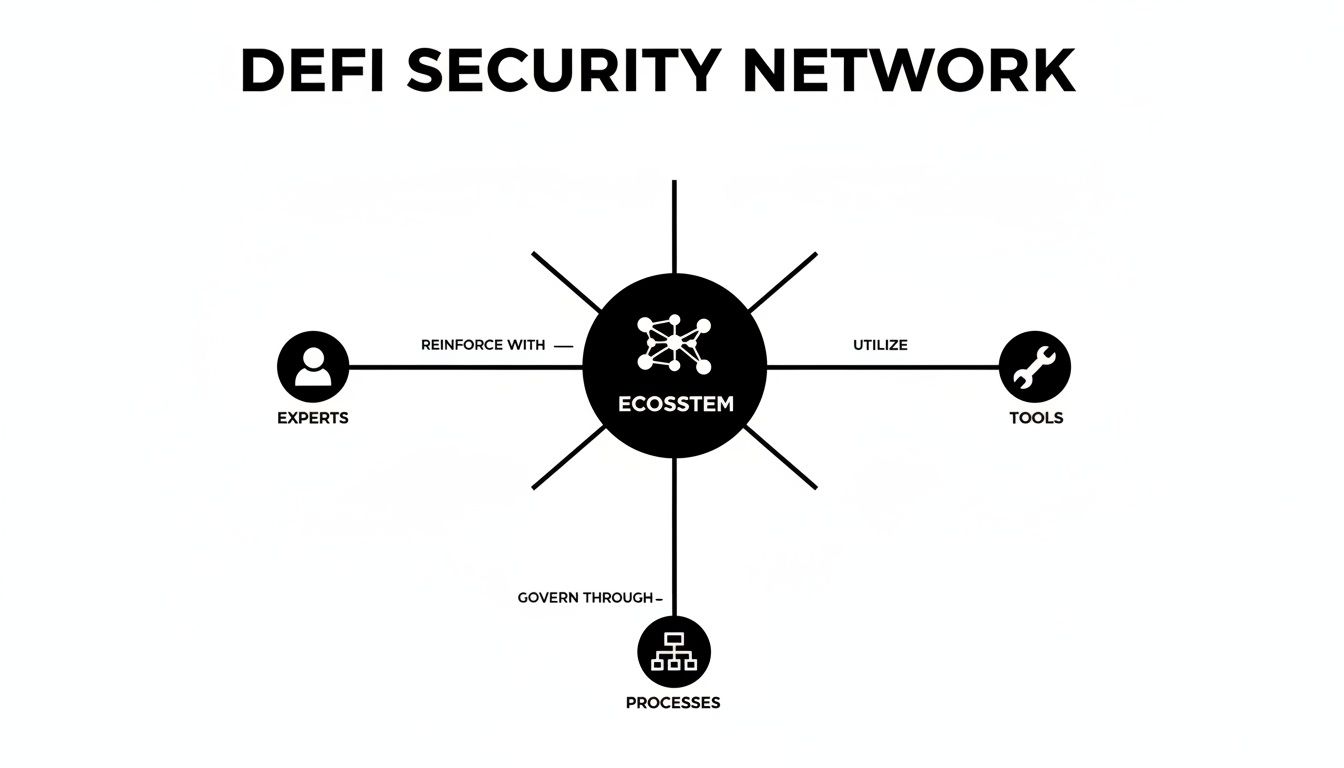
As you can see, a strong security audit network isn't about one thing—it’s an interconnected system where experts, tools, and processes all work in concert to fortify the DeFi space. Each element makes the others stronger.
Pillar 1: Smart Contract Audits
This is the most well-known pillar. A smart contract audit is a line-by-line inspection of the protocol's on-chain code—the logic that handles every transaction and holds all assets. Auditors meticulously hunt for common but devastating bugs like reentrancy, integer overflows, and access control flaws that hackers love to exploit.
A single vulnerability in a smart contract can lead to a catastrophic, total loss of user funds. This makes the smart contract audit the absolute, non-negotiable foundation of any project's security claims.
This process involves a mix of automated scanning tools and, crucially, manual expert review. The goal is to sniff out any logical error or vulnerability that could be manipulated. You can get the full rundown in our deep dive on smart contract security best practices.
Pillar 2: Network and Infrastructure Audits
While smart contracts live on the blockchain, most DeFi protocols rely on off-chain components to function. Network and infrastructure audits zero in on these critical support systems. These include:
- Servers and APIs: The back-end systems that serve the project's user interface.
- Oracles: Vital data feeds that pipe in off-chain information, like asset prices, to the smart contracts.
- Data Pipelines: Systems managing the flow of information between the on-chain and off-chain worlds.
- Private Key Management: The security procedures for storing and using the keys that control the protocol.
A weak spot here—say, a compromised API or a manipulated price oracle—can be just as destructive as a bug in the smart contract itself. This pillar ensures the entire operational stack is buttoned up.
Pillar 3: Formal Verification
This is the most rigorous, mathematically intense form of security analysis. Instead of just looking for bugs, formal verification aims to create a mathematical proof that the code behaves exactly as intended under every conceivable condition. Think of it as proving, with absolute certainty, that a bridge's design will never fail, no matter the load. That’s what formal verification does for code. Because it's so complex and expensive, it's usually reserved for only the most critical, high-value parts of a protocol.
Pillar 4: Community Bug Bounties
The final pillar harnesses the power of the global security community. A bug bounty program offers cash rewards to ethical hackers who find and responsibly report vulnerabilities that internal and external audit teams might have missed. This creates a continuous, crowdsourced audit, giving thousands of skilled researchers a real incentive to pick apart a project's code and providing an ongoing layer of defense that evolves as new attack methods emerge. Projects with generous and active bug bounty programs signal a strong, long-term commitment to keeping users safe.
Comparing the Four Pillars of DeFi Security Audits
Each type of audit plays a unique and critical role. While they can overlap, their primary focus and methods are distinct. The table below compares them side-by-side.
| Audit Type | Primary Focus | Example Tools & Methods | Protects Against |
|---|---|---|---|
| Smart Contract Audits | The on-chain code and business logic of the protocol. | Manual code review, static analysis tools (e.g., Slither), symbolic execution (e.g., Manticore). | Code-level vulnerabilities, logic errors, reentrancy attacks, integer overflows. |
| Network & Infrastructure Audits | Off-chain components like servers, APIs, oracles, and private key management. | Penetration testing, vulnerability scanning, cloud configuration reviews. | Hacked servers, compromised API keys, manipulated oracle data, private key theft. |
| Formal Verification | Mathematically proving that code meets its formal specification. | Theorem provers (e.g., Coq, Isabelle/HOL), model checkers (e.g., TLA+). | Critical logic flaws, unexpected state changes, violations of core assumptions. |
| Community Bug Bounties | Ongoing, crowdsourced vulnerability discovery across all project assets. | Public security research, responsible disclosure platforms (e.g., Immunefi, HackerOne). | Novel attack vectors, vulnerabilities missed by internal audits, continuous threats. |
Start tracking smart money today
Join thousands of traders using WalletFinder.ai to find profitable wallets and copy their trades.
Start Free Trial →

