What Is UTXO: Master Crypto Transactions in 2026

Wallet Finder

Blank calendar icon with grid of squares representing days.

June 11, 2026

You're probably looking at a wallet transfer, an exchange withdrawal, or a cluster of small incoming deposits and thinking: why does this look so messy on Bitcoin-style chains?

That confusion usually comes from one thing. You're expecting a wallet to work like a bank account. On a UTXO chain, it doesn't.

If you want the practical answer to what is UTXO, think like an on-chain trader, not a textbook reader. UTXO changes how wallets build transactions, how analysts track entities, how privacy breaks down, and why one wallet can become expensive to move at exactly the wrong time. For copy traders and researchers, this matters because the structure of a transaction often tells you as much as the transfer itself.

The UTXO Model Explained with an Analogy

A trader pulls up a Bitcoin wallet and sees one payment split into several outputs, plus a second output that appears to send funds back to the sender. It looks messy until you view the wallet the right way.

A UTXO is an unspent transaction output. On a UTXO-based chain, a wallet does not hold one editable balance. It holds separate chunks of value created by earlier transactions. Your displayed balance is just the total of those chunks.
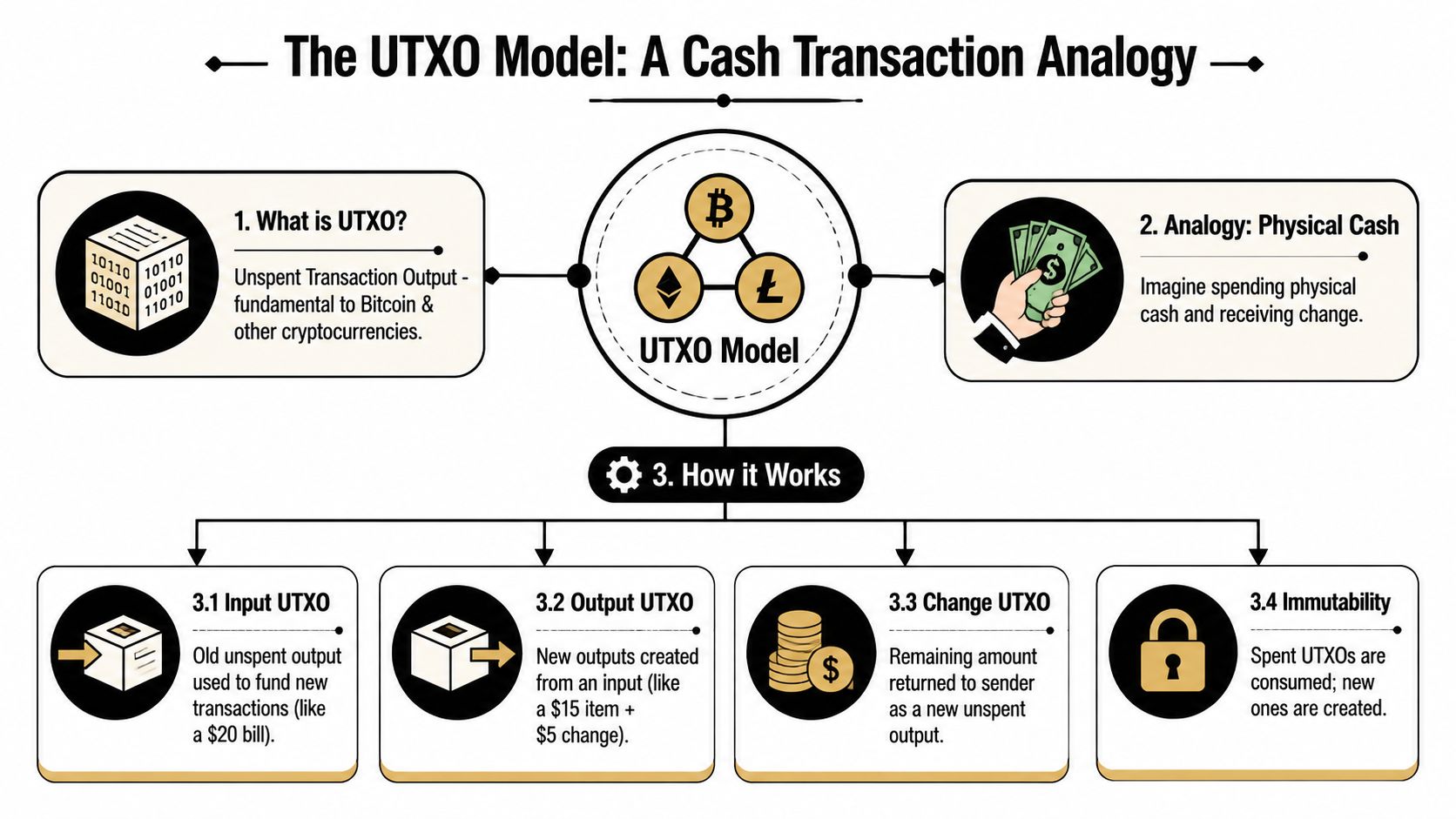
A diagram explaining the UTXO model of cryptocurrency transactions using a physical cash analogy.

Discrete pieces of value

The cash analogy works because spending on a UTXO chain behaves like spending physical bills.

Say your wallet controls the digital equivalent of:

  • a $20 bill
  • a $10 bill
  • a $5 bill

Your wallet shows $35. Under the hood, though, you do not have one $35 balance entry. You have three separate spendable outputs.

That detail matters. A UTXO is not an account balance that gets edited up or down after each transfer. It is a specific output from an earlier transaction. When you spend it, you consume that output in full. If the payment is smaller than the output you used, a new output is created for the recipient and another new output usually comes back to you as change, as explained in Learn Me A Bitcoin's overview of how Bitcoin UTXOs work.

Why traders and analysts should care

This structure changes how you read wallets on-chain.

A wallet with ten small UTXOs is different from a wallet with one large UTXO, even if both show the same total balance. The first wallet can be more expensive to move in a high-fee environment because the transaction may need to include many inputs. The second can be cleaner to spend, but it may reveal a clearer funding path when analysts trace where the coins came from.

That is why smart money tracking on UTXO chains goes beyond “wallet balance went up” or “wallet balance went down.” Analysts watch how outputs are grouped, how change is handled, and whether a wallet tends to merge coins, split them, or avoid combining them for privacy reasons.

Why the model exists

The design also makes validation simpler for the network. Nodes do not need to maintain a running bank-style ledger for each wallet. They check whether the specific outputs referenced in a transaction are still unspent.

Practical rule: On a UTXO chain, the wallet balance is a summary. The real objects that matter are the individual outputs.

If you've ever used a blockchain explorer guide for reading on-chain activity, this is the filter that makes Bitcoin-style transactions easier to read. What looks like clutter is usually useful information about coin selection, change handling, wallet behavior, and sometimes trader intent.

How UTXO Transactions Work Step by Step

A UTXO transaction is easier to read if you follow the coins as separate pieces, not as one wallet balance.
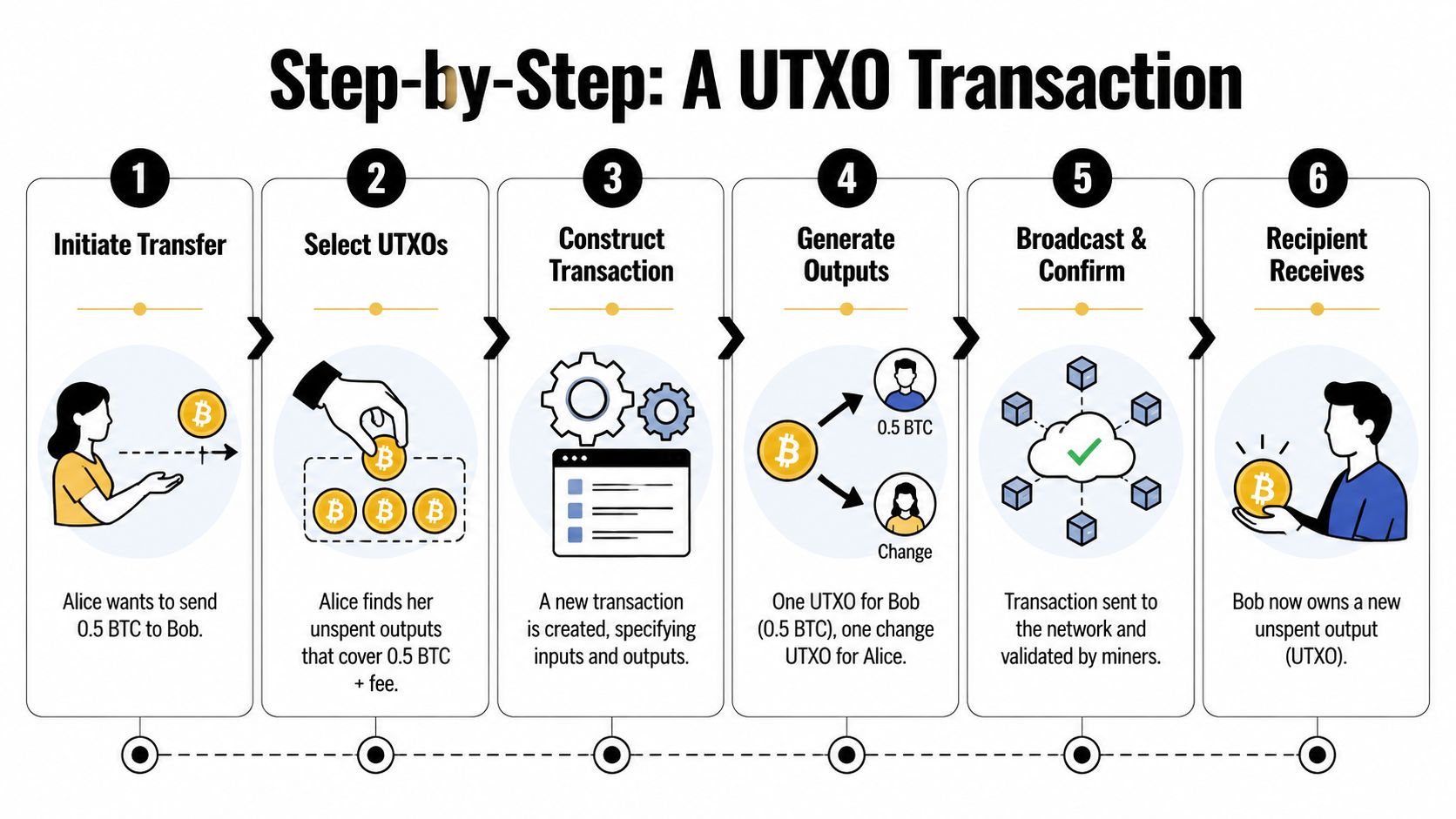
An infographic illustrating the six step-by-step process of a Bitcoin UTXO transaction from Alice to Bob.

A simple payment flow

Start with a trader wallet that holds three UTXOs: 0.2 BTC, 0.3 BTC, and 0.8 BTC. The trader wants to send 0.5 BTC.

The wallet cannot shave a piece off one UTXO and leave the rest sitting in place. It has to choose one or more full outputs as inputs, spend them, and create new outputs from that spend.

A typical flow looks like this:

  1. The wallet picks inputs
    It selects the UTXOs needed to fund the payment. In this example, it might choose the 0.2 BTC and 0.3 BTC outputs together, or it might spend the 0.8 BTC output alone.

  2. Those selected inputs are fully consumed
    Once an input is used in a transaction, that exact UTXO no longer exists as spendable value.

  3. New outputs are created
    One output sends value to the recipient. If the inputs add up to more than the amount being sent, another output returns the remainder to the sender as change.

  4. The fee is left behind implicitly
    On UTXO chains, the fee is usually the gap between total input value and total output value.

  5. The network checks the spend
    Each input must point to a real, unspent output from an earlier transaction. If any referenced output was already spent, the transaction fails validation.

That structure explains why one payment can produce multiple outputs and why the "change" side of a transaction often matters more to analysts than the payment side.

Why change exists

Cash is the right analogy. If you buy something for $30 with a $50 bill, you do not split the bill into a $30 piece and keep the rest in your hand. You hand over the full bill and receive $20 back as change.

A UTXO works the same way.

If your wallet spends a 0.8 BTC UTXO to send 0.5 BTC, the transaction may create:

  • 0.5 BTC to the recipient
  • change back to your wallet
  • a small remainder absorbed as the fee

That change is not the old coin with a lower balance. It is a new output with its own history, its own script, and its own role in future analysis.

Here's the compact version:

Transaction partWhat it means
InputAn older unspent output now being spent
Recipient outputA new output assigned to the payee
Change outputA new output returned to the sender
FeeThe difference between total input value and total output value

This short walkthrough can help if you want a visual explanation before going deeper:

What traders should notice

For trading and wallet tracking, the useful signal is often in the transaction shape.

  • Many inputs usually signal fragmented funds. A wallet that spends many small UTXOs may have been receiving funds over time, splitting size for operational reasons, or cleaning up dust.
  • The change output often marks the wallet's next move. If you are tracking a smart-money wallet, the fresh change UTXO is often the piece that gets spent again.
  • Inputs spent together can suggest common control. Analysts use that pattern carefully because coinjoin and privacy tools can break the assumption, but in ordinary wallet behavior it remains a strong clue.
  • Input choice affects fees. Spending ten small UTXOs is usually larger in byte size than spending one large UTXO, which can matter a lot when network fees rise.

A practical reading habit helps here. Do not stop at "wallet sent coins." Check which old outputs were consumed, which new output looks like change, and whether the wallet is merging, splitting, or consolidating funds.

That is the level where UTXO mechanics become useful for copy-trading, privacy analysis, and identifying whether a wallet operator is managing funds carefully or leaving a clear trail.

UTXO vs Account Model A Practical Comparison

Most confusion around UTXOs comes from switching mentally between two different systems.

Ethereum-style chains usually use an account model. Bitcoin-style chains use a UTXO model. If you copy-trade or analyze wallets across ecosystems, you need to know which system you're looking at because the same wallet behavior won't appear the same way on-chain.

Trust Wallet notes in its explanation of UTXO-based chains beyond Bitcoin that this isn't just a Bitcoin-only concept, and that the distinction matters for analysts comparing UTXO chains with account-model chains like Ethereum.

The practical difference

The account model feels like a bank ledger. One account has a current balance, and transactions update that balance.

The UTXO model feels like spending individual chips, notes, or tickets. Ownership is represented by separate outputs, and spending reshapes those outputs into new ones.

FeatureUTXO Model (e.g., Bitcoin)Account Model (e.g., Ethereum)
Unit of ownershipIndividual outputsAccount balance
Spending methodConsume specific outputs and create new onesAdjust balance up or down
Change handlingNew output returned to senderUsually just balance subtraction
Wallet viewSum of many discrete piecesOne running balance
Analysis styleOutput clustering and flow tracingAccount activity and state changes
Privacy behaviorMore selective visibility, but linkable when outputs are combinedBalance visibility is often more direct

Why copy traders should care

If you track wallets on Ethereum, you often follow a clearer account history. On a UTXO chain, the analyst's job is more forensic.

A few practical differences matter fast:

  • Balance interpretation changes: A visible wallet total on an account chain is usually straightforward. On a UTXO chain, you care about the composition of that total.
  • Wallet labeling is harder: One entity can control many addresses and many separate outputs.
  • Transaction intent is less obvious at first glance: What looks like one payment may also be internal reorganization, change handling, or consolidation.

For quants and serious retail traders, this means your heuristics shouldn't be copied across chains without adjustment. A “large wallet movement” in an account model and a “large UTXO reorganization” can look similar to a beginner, but they can mean very different things.

Why UTXO Matters for Wallet Tracking and Privacy

UTXO gives users some privacy advantages at the output level. It also creates some of the clearest leaks analysts can use.

Trezor's guide on UTXO privacy trade-offs and spending costs makes the key point well: a recipient doesn't automatically learn the sender's full balance from a single output. That's better than the simple account-balance mental model many people assume.

Where privacy improves

If someone receives one output from you, they see that output. They don't automatically see one neat “main account” the way they often would in an account-based system.

That makes UTXO systems feel more private at first glance. Funds can sit across many addresses and many outputs, and the full wallet picture may not be obvious from one transaction alone.

Where privacy breaks

The leak happens when outputs are spent together.

If a wallet operator combines multiple UTXOs into one transaction, analysts often treat that as a strong clue that the same entity controls them. That's useful if you're tracing a whale, an exchange cluster, or a wallet family linked to a strategy.

It's bad news if you thought using many addresses alone guaranteed privacy.

Here's what usually offers analysts an edge:

  • Input combination: Spending several outputs together can link them.
  • Change behavior: Repeated wallet software patterns can expose which output is change.
  • Small deposit buildup: Many tiny receipts often force later combination, which creates more linkable structure.

A wallet can look fragmented and private for months, then one badly timed spend links a large share of its history.

If you work with crypto transaction tracking tools and methods, this is one of the first things to internalize. On UTXO chains, privacy isn't just about addresses. It's about how outputs are later grouped.

The trader's angle

For copy traders, privacy leakage is useful data.

A wallet that repeatedly combines outputs before moving funds to an exchange may be preparing inventory for action. A wallet that avoids combining outputs may be protecting optionality and reducing linkability. Neither signal is perfect on its own, but both become meaningful when paired with timing, destination patterns, and repeated behavior.

For the wallet owner, the lesson is simple. UTXO structure gives you flexibility, but every spend is also a disclosure event.

UTXO Management for Traders and Analysts

A wallet can show 50 BTC and still be badly positioned for a fast trade.

If that balance sits in hundreds of tiny outputs, the owner may face higher fees, slower coin selection, and harder execution when the market turns. If it sits in a handful of well-sized outputs, that same wallet is easier to move with precision. For traders and analysts, that difference matters because UTXOs are inventory units, not just a balance line.

An infographic titled Smart UTXO Management illustrating five key strategies for crypto traders and analysts.

Why wallet shape matters

UTXOs work like cash in a physical wallet. One wallet with five $100 bills is easier to use for a $300 payment than a wallet stuffed with coins and small notes. On-chain, that same idea affects transaction size, fees, and flexibility.

For an active trader, wallet shape changes what is possible under pressure. A fragmented wallet may need to pull in many inputs to fund one transfer. That makes the transaction larger and often more expensive. A cleaner wallet can fund the same move with fewer inputs, which usually means lower fees and less information revealed on-chain.

This also changes how analysts read intent. A trader who reorganizes outputs before a volatile event may be preparing for speed, reducing future fee drag, or segmenting funds by purpose. If you work with blockchain data analytics for wallet behavior and trade setup detection, wallet shape is one of the first practical filters to apply.

A practical operating checklist

Use this checklist to manage a UTXO wallet or interpret one you track:

  • Consolidate with a reason: Merging small outputs can make future spending easier, especially if fees are calm and you expect to move size later.
  • Treat consolidation as a privacy tradeoff: Combining inputs can connect parts of a wallet history that were previously harder to link.
  • Watch dust before it becomes a problem: Tiny outputs can accumulate into operational clutter and may cost more to spend than they are worth under some fee conditions.
  • Pre-build spendable inventory: If you expect to react fast, keeping a few clean outputs in useful sizes can reduce friction during execution.
  • Separate housekeeping from intent: A wallet cleanup transaction may prepare for action, but it can also be routine maintenance. Timing, destination, and follow-through matter.

What analysts should flag

The strongest read often comes from how a wallet prepares, not from the final transfer itself.

Here are patterns worth marking:

PatternPossible interpretation
Many small inputs merged into one or two outputsFee cleanup, trade preparation, or inventory simplification
Several medium-sized outputs created togetherPre-positioning funds for flexible future transfers
Dust left untouched while larger outputs are preservedSelective coin control and intent to avoid unnecessary linkage
Repeated internal reshuffling with no exchange interactionWallet organization, fund segregation, or custody workflow

A useful question is simple: what can this wallet do next, given the outputs it now holds?

That framing is what makes UTXO analysis useful for copy trading. You are not only tracking where funds went. You are assessing whether a wallet is ready to deploy capital, forced to consolidate first, or trying to keep future paths less visible.

Advanced On-Chain Analysis with UTXO Data

Once you understand outputs, you stop reading transfers as simple sends and receives. You start reading wallet behavior.

That's the edge. UTXO data often reveals preparation, constraint, and intent before a headline move becomes obvious.

What sophisticated patterns look like

Here are a few patterns worth watching:

  • Large consolidation before a major move
    A wallet may merge scattered outputs into cleaner chunks before sending funds onward. That can precede exchange interaction, treasury movement, or a large transfer.

  • Many same-sized outputs created together
    This can suggest structured distribution, operational batching, or preparation for repeated future spends.

  • Repeated change behavior
    Over time, some wallets show recognizable output selection and change patterns. Analysts use that consistency to improve clustering.

  • Fragmented incoming flow with delayed aggregation
    This can indicate a wallet accumulating from multiple sources before acting.

None of these patterns should be read in isolation. The signal comes from repetition, destination context, and timing.

Screenshot from https://www.walletfinder.ai

What this changes for copy trading

Most traders react to visible buys and sells. Better analysts also watch the setup.

If a tracked wallet starts consolidating, that may tell you it's getting operationally ready. If it preserves larger outputs instead of fragmenting them, that can suggest it wants future flexibility. If it keeps many outputs separate, it may be balancing privacy and execution costs.

This is why understanding raw transaction structure makes you better at interpreting alerts, labels, and entity maps. A platform may simplify the view, but the underlying logic still comes from output-level behavior and chain-specific data design. If you want the broader research angle, this overview of blockchain data analytics methods is a useful companion.

The traders who get the most from on-chain data don't just follow wallet actions. They read wallet preparation.

A good analysis habit

Before you tag a movement as bullish, bearish, or irrelevant, ask:

  1. Is this transfer external, or is it internal restructuring?
  2. Did the wallet need many inputs to make it happen?
  3. Was change handled in a way that reveals future wallet state?
  4. Is this consistent with earlier behavior from the same entity?

That habit won't make every interpretation right. It will make your reads far less naive.

Frequently Asked Questions About UTXOs

Can a UTXO be partially spent

A UTXO works like a cash bill. You spend the whole bill, then get change back as a new output.

For traders, that detail matters because one transfer can create a fresh piece of wallet state. If you are tracking a wallet, the payment output is only part of the story. The change output often shows where funds remain.

Does a wallet balance exist on a UTXO chain

Yes, but the balance your wallet shows is a calculation, not a single on-chain bucket.

The wallet adds up every unspent output it controls and presents the total as one number. That is convenient for users, but analysts should remember what sits underneath. A wallet with a 5 BTC balance might hold one large output, fifty small outputs, or some mix of both. Those cases can behave very differently when the wallet trades, consolidates, or pays fees.

Why does my wallet use so many addresses

Wallet software often generates new addresses to receive funds, return change, or separate activity.

That can make casual tracking harder, but it does not guarantee privacy. If several outputs are later spent together in one transaction, analysts can often treat that as a strong clue that one entity controls them. For copy-traders, this is why raw address counts can mislead. You are usually tracking a cluster of behavior, not one neat address.

Are UTXOs only a Bitcoin thing

No. Several blockchains use a UTXO-style design, while others use account balances.

The practical difference is important for on-chain analysis. On a UTXO chain, you follow individual outputs, how they are split, and how they are recombined later. On an account-based chain, you usually read balance changes more directly. If you compare wallets across chains without adjusting for that difference, you can misread intent, wallet size, or trading activity.

Do old UTXOs expire

Old UTXOs can sit untouched for years and still remain spendable.

A key issue is wallet hygiene. A wallet that has collected many tiny outputs may cost more to spend later, and it may reveal more about ownership if those pieces need to be combined. Active traders sometimes clean this up during lower-fee periods so future transfers are easier to execute and easier to control from a privacy standpoint.


If you track smart money, copy winning wallets, or want cleaner context behind on-chain moves, Wallet Finder.ai helps turn raw wallet activity into usable signals. You can monitor profitable wallets, review full trading histories, and react faster when tracked traders buy, sell, or rotate.