Account Abstraction Wallets: The Future of Crypto in 2026
Unlock account abstraction wallets' power. This guide covers EIP-4337, social recovery, sponsored gas, & tracking smart wallets for a DeFi edge.

June 2, 2026
Wallet Finder

June 2, 2026

Millions of smart-wallet actions have already hit Ethereum through the ERC-4337 path. For traders, that means account abstraction is no longer a niche wallet design choice. It is part of live market structure.
An account abstraction wallet turns the wallet from a simple signer into programmable execution logic. Rules can sit at the account level. Orders can be batched. Gas can be sponsored. Recovery can follow defined permissions instead of a single seed phrase. That changes how trades get placed, how operators split risk, and how wallet activity should be tracked.
The useful frame is to analyze where these wallets improve execution, change the security perimeter, and create on-chain signals before the broader market reacts.
That matters for PnL. Lower friction can tighten multi-step entries and exits. Better permissioning can make team trading setups less fragile. The trade-off is a wider attack surface that now includes wallet code, paymasters, bundlers, session keys, and recovery logic. Traders who ignore those moving parts will misread both risk and opportunity.
It also creates a tracking edge. Smart wallets often leave different operational fingerprints than EOAs, especially around batching, automation, and delegated permissions. That gives copy traders and wallet intelligence tools new data to work with, but it also raises a harder question: if you mirror a profitable AA wallet, are you copying the trader's intent or just one layer of a more complex execution stack?
Smart wallet activity has already moved from edge case to live order flow on Ethereum. For traders, that changes the job of a wallet from custody tool to execution infrastructure.
An account abstraction wallet can encode rules at the account level. That means transaction batching, custom signing policies, sponsored gas, delegated permissions, and recovery logic are part of the wallet itself instead of being patched together with extra apps and operational workarounds.
The old EOA model is simple, but simplicity cuts both ways. One compromised key can expose the whole account. One lost seed phrase can freeze capital. Skilled operators have always worked around that with wallet sharding, hardware devices, and strict process. Account abstraction shifts part of that burden into code.
On Ethereum, ERC-4337 made that model usable in production without waiting for a base-layer wallet redesign. Adoption is far enough along that traders should treat smart accounts as a real part of market structure, not a future feature.
That has direct trading consequences.
The headline is not better onboarding. The headline is better control over execution, access, and operational risk.
One practical implication stands out. A profitable AA wallet is not just a wallet to monitor. It is a strategy wrapper. If you use tools like Wallet Finder.ai to track and mirror smart-wallet activity, you need to separate the visible transaction from the hidden permission model behind it. That is where copy traders can gain edge or copy the wrong signal.
Treat account abstraction wallets the way you would treat a router, bridge, or execution bot. Review who controls what, which components sit in the path, and how the setup behaves when markets get fast.
A good analogy is a house key versus a programmable smart lock.
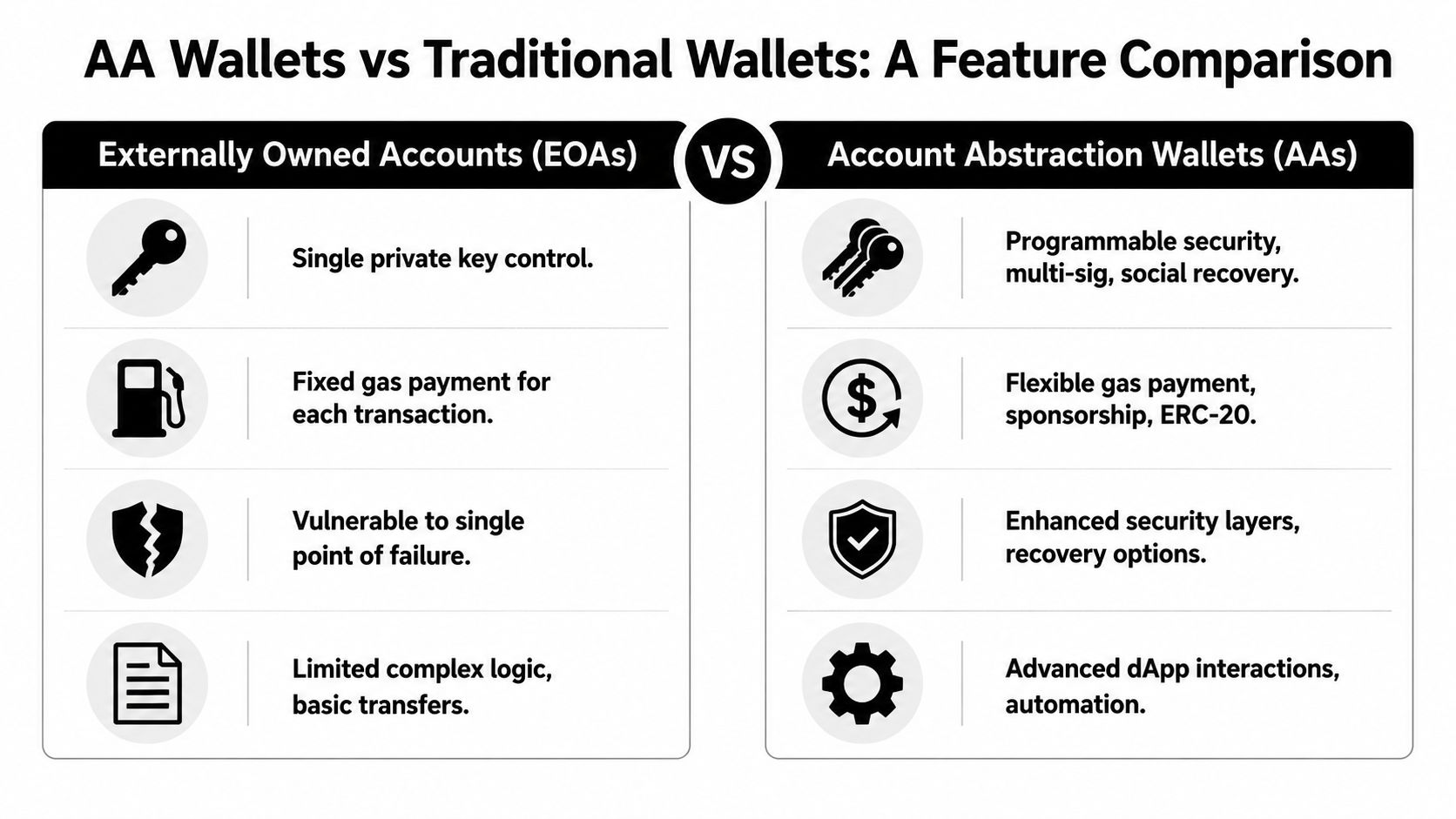
An EOA is the house key. If you have it, the door opens. If someone steals it, they get in. An account abstraction wallet is the smart lock. It can allow one person in for five minutes, require two approvals after midnight, or reject large transfers unless extra conditions are met.
That flexibility is why account abstraction wallets matter.
Conduit's overview of ERC-4337 explains the core shift clearly. Account abstraction wallets are a smart contract account model, and ERC-4337 was designed to support that without changing Ethereum's core protocol. It introduced building blocks like smart wallets and UserOperations, letting developers encode wallet logic directly into the account for features such as gas sponsorship, social recovery, and custom validation, as described in Conduit's account abstraction guide.
For traders, “custom validation” is the phrase to focus on. That's where strategy and safety start to overlap.
| Feature | Traditional Wallet (EOA) | Account Abstraction Wallet |
|---|---|---|
| Control model | One private key usually acts as the main authority | Smart contract logic defines who can authorize actions |
| Recovery | Loss of seed phrase or key is usually terminal | Recovery can be designed into the wallet workflow |
| Transaction flow | One action at a time, manual signing is common | Multiple actions can be coordinated through wallet logic |
| Gas handling | User usually needs native gas token | Fees can be sponsored or abstracted depending on setup |
| Permissions | Broad wallet-level control | Granular permissions can be assigned by rule |
| Automation | Limited at the wallet layer | Rules, session access, and validation can be programmed |
| Attack surface | Key theft and phishing dominate | Key risk remains, plus contract and infrastructure risk |
The catch is that flexibility doesn't automatically mean safety. It means you're replacing a simple security model with a programmable one. Sometimes that's a huge improvement. Sometimes it's just more moving parts.
Most Ethereum account abstraction wallets in the market today rely on ERC-4337. The easiest way to think about it is a mailroom.
You don't walk your own letter into the back of the sorting facility. You write the instructions, hand them off, and specialized actors process and deliver them.

Cobo's explanation is still the cleanest practical summary. On Ethereum, ERC-4337 implements account abstraction without changing the core protocol. Users create UserOperations, bundlers package and submit them to the EntryPoint contract, optional Paymasters can cover fees, and aggregators can compress signature verification overhead, as outlined in Cobo's account abstraction wallet breakdown.
Here's what that means in plain English:
UserOperation
This is your instruction packet. It says what you want the smart account to do.
Bundler
This actor collects many UserOperations and packages them for submission.
EntryPoint
Think of this as the central router and validator. It checks the operation path and triggers execution.
Paymaster
This is the fee sponsor. If a dApp wants to subsidize activity, the paymaster can handle that side of the flow.
This architecture enables three things that have direct market impact.
First, it supports sponsored execution. If a protocol wants to acquire users fast, it can remove native gas friction. That changes wallet behavior, funnel conversion, and sometimes short-term order flow quality.
Second, it allows batched interactions. A trader can bundle several dependent actions into a single wallet-level flow instead of manually stepping through each signature.
Third, it creates new on-chain signals. Subsidy behavior, smart account deployment patterns, and repeated wallet logic all leave traces that analysts can monitor.
If you want a deeper primer on the wallet side of that architecture, this explanation of smart contract wallets is useful alongside the protocol-level view.
A quick visual helps before going further.
| System part | Mailroom analogy | Trading relevance |
|---|---|---|
| UserOperation | The letter you write | Your intent and execution instructions |
| Bundler | The mail carrier | Determines how operations get packaged and submitted |
| EntryPoint | The post office | Central processing for validation and execution |
| Paymaster | Someone paying your postage | Enables gasless or subsidized user flows |
When a dApp removes the need to hold ETH just to complete a flow, it isn't being generous. It's buying lower friction.
That doesn't mean the model is bad. It means you should read incentives correctly. If a protocol is paying to reduce user pain, ask what behavior it wants in return.
The right way to evaluate account abstraction wallets is feature by feature, then ask whether each one changes execution quality, operational security, or your ability to run a repeatable strategy.

Starknet's framing is useful here. The main advantage is that the wallet becomes a policy engine. It can enforce custom validation before execution, including spending limits, time locks, or multiple approvals, which helps reduce the blast radius of compromised keys and supports non-custodial recovery workflows, as described in Starknet's account abstraction overview.
Batching is one of the few wallet features that can directly clean up slippage and operational mess.
A common DeFi sequence might involve approving a token, swapping it, depositing the output somewhere else, and then staking or allocating collateral. In a traditional setup, that often means repeated signatures and more time for pricing or state to move between steps. In a smart account flow, those actions can be bundled into one coherent execution path.
For traders, the edge isn't magic. It's fewer opportunities to make manual mistakes.
Gas sponsorship sounds cosmetic until you watch how much user behavior depends on it.
If a trader doesn't need native gas on hand for a first action, onboarding into a strategy becomes easier. If a protocol covers transaction fees for a campaign, it can push usage into parts of the stack that would otherwise see much less flow. That matters because subsidized flows often create temporary pockets of volume, wallet creation, and repeat interaction.
From a strategy standpoint, don't just celebrate the convenience. Track where subsidies are concentrated. They often point to the protocols trying hardest to manufacture growth.
A lot of commentary treats social recovery as a retail onboarding feature. It's more than that.
A serious operator can use programmable recovery and permissions to separate risk:
Session keys are one of the most interesting features for frequent on-chain activity because they can authorize a narrower class of actions without requiring full wallet approval every time.
That's useful in high-frequency environments, gaming loops, and any setup where constant prompts hurt execution. But the trading takeaway is sharper: session keys can improve speed only if the permission scope is extremely tight. A broad session key is just a faster path to a bad loss.
Execution takeaway: Every convenience feature in an AA wallet should map to a measurable operational gain. If it doesn't improve speed, control, or recovery, it's just complexity.
The marketing version of account abstraction is simple. No seed phrase anxiety. Better recovery. Better UX.
The complete picture is more nuanced. You aren't eliminating trust. You're redistributing it.

Independent coverage on account abstraction makes the key point plainly. The programmability of smart-contract wallets means the wallet's validation logic becomes part of the attack surface. Users need to ask whether a recovery system is safer than a seed phrase, what happens if trusted contacts are compromised, and how much trust has shifted from key management to contract logic and outside infrastructure, as discussed in Crypto for Innovation's analysis of account abstraction risk.
That's the right starting point for a threat model.
With an EOA, the main question is often, “Can this key get stolen or phished?” With an AA wallet, you still ask that, but you also ask:
For traders and copy desks, three risks matter most.
If guardians are weakly chosen, socially engineered, or coordinated badly, social recovery stops being a safety feature and starts becoming an alternate takeover route. Recovery design matters more than recovery branding.
A smart wallet can be beautifully designed on the surface while embedding unsafe defaults in spending limits, session permissions, fallback handlers, or upgrade rights. If you don't understand those assumptions, you're outsourcing judgment to code you didn't write.
Bundlers and fee sponsors improve usability, but they also add operational dependencies. If a sponsored path is unavailable, changes terms, or behaves inconsistently under load, your execution experience changes with it.
For traders, reliability is part of security. A wallet that works until the market gets chaotic isn't strong enough.
A useful supplemental read on the broader mechanics of smart contract hacking helps frame why wallet code deserves the same scrutiny traders give to protocols.
Use this checklist before parking serious capital in an AA wallet:
| Question | Why it matters |
|---|---|
| What can authorize a transfer? | Determines whether one device, one signer, or one policy failure can drain funds |
| How does recovery work? | Recovery should be resilient without being easy to hijack |
| Are permissions granular? | Narrow scopes reduce damage from compromised sessions or devices |
| Who controls upgrades? | Upgrade rights can be a hidden trust assumption |
| What infrastructure does the wallet rely on? | More dependencies can mean more failure points |
Don't compare an AA wallet to the idealized version of an EOA. Compare it to your actual setup, including your own opsec, your signing habits, and how many mistakes your current process already invites.
That's where the honest answer usually sits. A well-designed AA wallet can be safer than most human-operated EOA setups. A sloppy one can be worse.
Account abstraction wallets create richer on-chain behavior than ordinary EOAs. That makes them more interesting to analyze.
A simple transfer from a vanilla wallet doesn't say much beyond direction and amount. A smart account can reveal repeated policy patterns, sponsored interactions, bundled sequences, and app-specific execution habits. For traders, that means these wallets can produce better signals if you know how to read them.
Ledger's commentary on account abstraction points to the economic question that matters most: who pays. When gas sponsorship and one-click onboarding show up, traders should ask what that subsidy signals. Tracking those flows can reveal which dApps are funding growth, and that can create opportunities before the subsidies disappear, as noted in Ledger's account abstraction market view.
That gives you a useful watchlist framework.
Explorers are fine for transaction lookup. They're weaker when you need to interpret intent across smart wallet infrastructure.
AA activity can look noisy if you're only reading the outer transaction shell. The meaningful part may be in the UserOperation pattern, the paymaster relationship, or the recurring internal action sequence. That's where many traders miss the signal.
If your process for wallet tracking stops at token transfers, you'll miss a chunk of what makes smart accounts useful to monitor.
A broader workflow for tracking crypto wallets becomes much more important once wallet logic itself starts affecting execution patterns.
Use a three-pass process.
Identify the wallet type
Don't assume every active address is a vanilla EOA. Classify smart account behavior first.
Map the recurring flow
Look for repeated sequences, not one-off transactions. The repeated path matters more.
Separate subsidy from conviction
If a wallet's behavior depends on fee sponsorship, ask what happens when the incentive disappears.
Mirroring AA wallet activity can be useful, but you need to avoid copying the wrapper while missing the logic underneath.
If a profitable wallet relies on sponsored gas, private routing, narrow permissions, or app-specific automation, your attempt to imitate it from a standard wallet may not reproduce the same result. The sequence may be copyable while the edge isn't.
That's the core “so what.” Account abstraction wallets aren't just new containers for capital. They're new behavioral artifacts. Traders who can decode those artifacts get a better read on where smart money is experimenting, where protocols are spending to shape behavior, and which patterns are strong enough to mirror.
The account abstraction space matters less as a brand ranking exercise and more as a map of use cases.
Different wallet teams are pushing the model in different directions. Some are optimized for self-custody UX. Some grew out of multisig and treasury operations. Others focus on developer infrastructure and app onboarding. If you're trading on-chain, those distinctions matter because the wallet design affects how users behave.
These are the wallets that usually attract active on-chain users who want tighter execution, recoverable access, and more control over permissions than EOAs provide. They tend to appeal to traders who care about multi-step interactions, risk compartmentalization, and smoother app use.
When this category improves, DeFi gets more usable for active capital. More advanced wallet behavior often follows.
Wallets in the Safe tradition matter because they normalized the idea that asset custody and transaction authorization don't have to be the same thing. For desks, DAOs, and funds, that separation is often the whole point.
The ecosystem impact is larger than most retail users realize. Once teams get comfortable with policy-based authorization, the leap to broader account abstraction features becomes much smaller.
This group is trying to make crypto feel less like raw blockchain operations and more like an app. The emphasis is often gas abstraction, easier login, recoverability, and fewer visible blockchain-specific steps.
That may sound retail-heavy, but traders should pay attention. Better onboarding changes the composition of users entering protocols. It can also create temporary inefficiencies when new cohorts arrive through sponsored or heavily simplified flows.
What works:
What doesn't work as well:
As account abstraction wallets spread, they raise the baseline expectation for what wallets should do. Users start expecting recovery options, lower gas friction, and fewer pointless signatures. Protocols start designing flows around those assumptions. Wallet infrastructure becomes part of product design, not just account access.
That has two market consequences.
First, UX standards shift. Projects that still force clunky EOA-only flows can start to look outdated fast.
Second, on-chain behavior becomes easier to segment. Once wallet logic varies more, analysts can infer more from how accounts interact with dApps. That creates better wallet clustering, better strategy inference, and potentially better copy-trading filters.
The wallet layer used to be mostly inert. It isn't anymore.
They can be. The answer depends on who can authorize actions, who can change wallet logic, and who controls recovery.
A smart account with user-controlled signers, clear recovery rules, and no hidden admin path is still self-custody in practice. A wallet that relies on upgrade keys held by a company, offchain policy servers you cannot inspect, or recovery flows that can override your signer starts to look closer to managed custody. Traders should read the control model before sizing in. The label matters less than the power map.
No. They shift risk rather than removing it.
EOAs concentrate risk in a single key. AA wallets can spread risk across multiple signers, session keys, spending limits, and recovery logic. That is an improvement if the contract code is clean and the policy design is tight. It becomes a bigger attack surface if the wallet includes weak modules, careless delegate permissions, or an upgrade path that users never review. For copy traders, this matters because a profitable wallet may be safe for its owner's setup but dangerous to mirror if your wallet stack cannot enforce the same controls.
Yes. Smart accounts do not save traders from sloppy operations.
The signer on your phone, your browser extension, your hardware wallet, your recovery contacts, and your approval habits still decide whether funds stay safe. AA helps reduce single points of failure, but it also introduces new ones. A compromised session key with narrow permissions is very different from a compromised owner key with broad authority. You need to know which one you are using.
They are subsidized, not free.
Someone covers the cost, usually a dApp, wallet provider, market maker, or another intermediary trying to drive a behavior. That can be useful if it gets you into a trade faster or lets you rebalance smaller positions that would otherwise be uneconomic. It can also distort what you see onchain. If the wallet you are tracking receives sponsored execution, its strategy may not translate cleanly to your own account once you pay normal gas and slippage.
They can be, especially when smart accounts make recurring behavior easier to identify.
A trader using batching, automation, or session keys often leaves a more structured footprint than a trader using a plain EOA. That helps with wallet clustering and strategy inference. The catch is execution parity. If the source wallet uses sponsored gas, custom permissions, or automation that triggers based on offchain conditions, mirroring the raw transaction stream can produce worse entries, failed follow-ons, or risk exposure you did not intend. The edge is in understanding the wallet logic, not just copying the calldata.
Start with four points: authorization rules, recovery design, upgrade rights, and outside dependencies.
Then test the wallet the way you would test a venue. Send small size first. Review what signatures it asks for, whether permissions can be scoped tightly, how easy it is to revoke access, and what happens if the wallet provider disappears or its relayer fails. If any of that is fuzzy, the wallet deserves a higher risk discount.
If you are tracking AA wallets for signals, apply the same standard to the wallets you follow. A wallet with strong returns but weak control assumptions can become a bad copy-trading input fast.
If you want to turn wallet behavior into something tradeable, Wallet Finder.ai helps you identify profitable on-chain wallets, inspect full trading histories, monitor entries and exits, and track smart money across major ecosystems in real time. For traders trying to understand which wallets are worth following, it's a practical way to move from raw on-chain noise to actionable signals.