Bullish Abandoned Baby: Candlestick Pattern Mastery
Master the powerful bullish abandoned baby pattern. Learn identification, backtested reliability, and trading rules with on-chain examples.

April 12, 2026
Wallet Finder

April 12, 2026

Most advice on this topic is too simplistic. People say Coinbase Wallet is decentralized, then stop there.
That answer is incomplete.
If you're a trader, the better question is this: decentralized in what way, and enough for what job? A wallet can give you self-custody while still leaning on centralized rails for distribution, user experience, or network access. That matters if you're tracking wallets, copying trades, protecting size, or trying to reduce identity leakage.
The phrase is coinbase wallet decentralized deserves a nuanced answer. Coinbase Wallet is not the same thing as the Coinbase exchange, and that distinction changes who controls assets, how transactions get submitted, and what other traders can infer from on-chain behavior.
The biggest mistake traders make is treating Coinbase and Coinbase Wallet like one product.
They aren't.
Coinbase.com is a centralized exchange. Coinbase Wallet is a separate self-custodial wallet. That difference isn't branding. It's the line between the company controlling your keys and you controlling them.
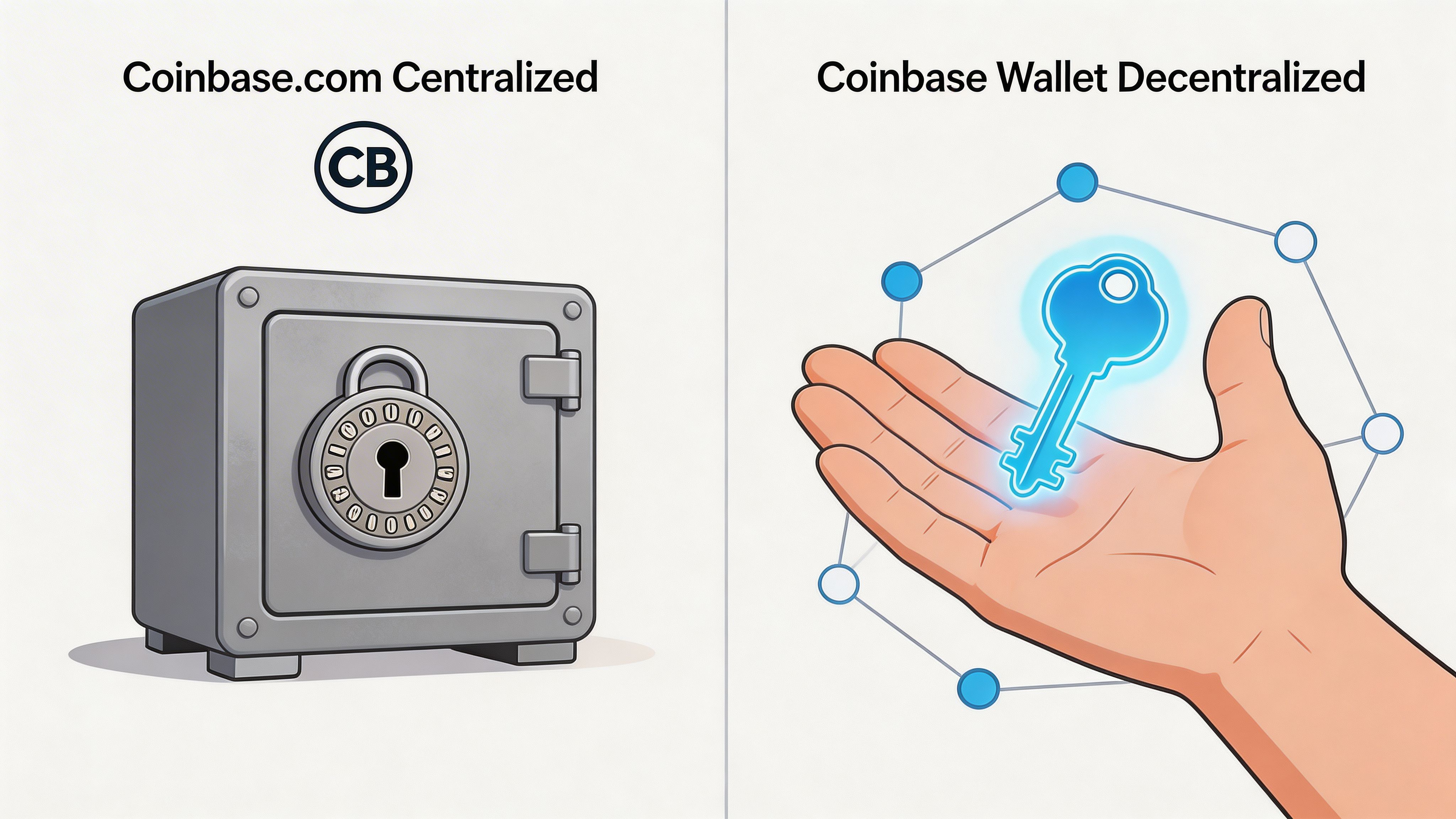
Coinbase states that Coinbase Wallet is a self-custodial, decentralized wallet where users control their private keys, and by 2025 it had 3.2 million monthly active users, equal to 2.7% of Coinbase's 120 million monthly platform users, according to Coinbase wallet security information.
On the exchange, Coinbase manages custody. In a self-custody wallet, the user signs transactions directly.
That changes three practical things:
Use this mental model:
| Product | Who holds the keys | Where activity happens | Best for |
|---|---|---|---|
| Coinbase.com | Coinbase | Inside a centralized platform until you withdraw | Buying, selling, convenience |
| Coinbase Wallet | You | Directly on-chain | DeFi, NFTs, dApps, on-chain trading |
If you're still comparing the exchange and the wallet as if they offer the same kind of control, this breakdown of whether Coinbase is safe to store crypto is the right companion read.
The word "Coinbase" tells you almost nothing about decentralization. The custody model tells you everything.
For wallets, decentralization isn't a slogan. It's a set of properties.
The first property is key custody. The second is transaction independence. A third, often ignored, is whether the software and network connections leave you with practical escape routes if a provider changes policy.
Coinbase Wallet fits the first two better than many beginners realize.
According to this Coinbase Wallet security analysis, private keys are generated and stored on the user's device, and blockchain interactions bypass Coinbase intermediaries entirely and execute directly peer-to-peer on-chain.
A custodial wallet is like a safe deposit box at a bank. You have access, but the institution still runs the building, verifies identity, and can control the process around access.
A self-custody wallet is like a safe in your home. Nobody stands between you and the contents. That's freedom, but also liability. If you lose the combination, there isn't a branch manager to call.
That gets to the core of wallet decentralization. It's less about whether a brand is famous and more about who can act without asking permission.
This is the foundation.
If the wallet creates and stores keys locally, and only the user can sign transactions, the wallet is decentralized in the most important sense. Coinbase Wallet passes this test.
For traders, this means:
A decentralized wallet should let you interact with blockchains and dApps without a company approving each move.
In practical terms, that means you sign a transaction and broadcast it to the network. The wallet app may make this easier or harder, but it shouldn't be the authority deciding whether your funds move.
This point confuses people. A wallet can be self-custodial even if parts of its experience depend on centralized infrastructure.
Examples include:
None of those automatically makes a wallet custodial. They do affect how decentralized the full experience feels in practice.
Practical rule: Ask two separate questions. "Who holds the keys?" and "What dependencies shape the user experience?" Most wallet debates blur them together.
People often assume a wallet is either fully decentralized or fully centralized.
That's not how this works.
A wallet can be decentralized at the custody layer and still have centralized touchpoints at the software, privacy, or infrastructure layer. That's why traders should evaluate wallets as a spectrum, not a binary.
The short answer is yes. Coinbase Wallet is decentralized in the custody sense. The longer answer is that it sits in the middle of the decentralization spectrum once you include infrastructure and ecosystem dependencies.
That's the trader's answer, and it's the useful one.

At the key layer, the wallet is doing the right thing. You hold the cryptographic credentials. You sign transactions. Assets live on-chain under your control, not in Coinbase's omnibus custody.
That has a direct consequence for analysts and copy traders. Activity from a Coinbase Wallet address is visible as wallet activity, not hidden inside exchange internals.
This is why self-custody wallets matter so much for on-chain research. They produce cleaner on-chain footprints.
A wallet app is still software. Software depends on distribution, interfaces, default providers, and surrounding networks.
Some likely friction points include:
That doesn't cancel decentralization. It does create points where convenience and independence pull in different directions.
Coinbase Wallet integrates with Base, Coinbase's Layer 2 that uses Optimistic Rollups. That setup enables faster and cheaper transactions while relying on Ethereum for final security, according to this analysis of Base architecture.
For traders, that's attractive. Lower-cost execution makes strategy testing, scaling in, and tracking mirrored positions easier.
But there's a catch. The same source notes that Base's reliance on Coinbase as a sequencer introduces centralization concerns.
Think of Ethereum as a public highway and Base as a managed express lane connected to it.
You still reach the broader road system. But one operator has meaningful influence over how traffic is ordered in that lane. That's not the same as Coinbase controlling your wallet keys. It is a separate dependency worth understanding.
| Pillar | Coinbase Wallet assessment | Why it matters |
|---|---|---|
| Key custody | Strong | You hold private keys and sign transactions |
| On-chain execution | Strong | Transactions go to the blockchain, not an exchange ledger |
| dApp access | Strong | Useful for DeFi, NFT, and multi-chain activity |
| Infrastructure independence | Mixed | Many users rely on default software rails |
| Network decentralization on Base | Mixed | Base improves usability but has sequencer-related concerns |
If you want a deeper risk lens beyond decentralization alone, this breakdown of how secure Coinbase Wallet is helps frame the operational side.
A self-custody wallet can still sit on partially centralized plumbing. That's not hypocrisy. It's the normal trade-off of consumer crypto products.
Coinbase Wallet is not "fully decentralized" in the purist sense.
It is, however, meaningfully decentralized where traders care most: asset control, direct signing, and on-chain interaction. Its biggest compromises show up in surrounding infrastructure and in the Coinbase-linked ecosystem around Base, not in who holds your funds.
A side-by-side comparison makes this much clearer than philosophy does.
The fundamental choice isn't between decentralized and centralized in the abstract. It's between different bundles of control, convenience, and operational responsibility.

| Feature | Coinbase.com (Custodial) | Coinbase Wallet (Self-Custody) | MetaMask (Self-Custody) |
|---|---|---|---|
| Key custody | Coinbase holds keys | User holds keys | User holds keys |
| Transaction control | Platform-managed environment | User signs on-chain | User signs on-chain |
| DeFi access | Limited compared with a wallet | Native wallet use for dApps and DeFi | Native wallet use for dApps and DeFi |
| Recovery model | Account recovery through platform processes | Recovery depends on wallet backup methods and user control | Recovery depends on seed phrase management |
| Privacy posture | Tied to exchange identity and compliance flows | Better custody independence, but ecosystem links can still matter | Self-custody, with privacy depending on wallet usage patterns |
| Best fit | Convenience and fiat onramps | DeFi users who want easier onboarding | Users who prioritize flexibility and broad wallet-native usage |
Coinbase.com is the least decentralized of the three because custody sits with the company.
MetaMask is usually the cleaner reference point for a self-custody wallet in the minds of experienced DeFi users. Coinbase Wallet sits closer to MetaMask than to Coinbase.com on the custody question.
A trader using Coinbase.com often has smoother account recovery and simpler fiat flows.
A trader using Coinbase Wallet or MetaMask gets direct on-chain access, but also takes on the burden of key management, approvals, and wallet hygiene.
Here’s a useful visual explainer before the finer distinctions:
Coinbase Wallet often appeals to traders who want a more guided entry into self-custody while staying close to the Coinbase ecosystem.
MetaMask usually appeals to users who want a more wallet-native, ecosystem-agnostic feel.
That doesn't make one universally better. It means they optimize for different habits.
For a sharper head-to-head on wallet choice, this comparison of Coinbase Wallet vs MetaMask is the most relevant next step.
For traders, decentralization isn't ideological. It's operational.
You want to know whether a wallet gives you clean on-chain execution, reliable visibility, and acceptable privacy for the strategy you're running. Coinbase Wallet is strong on the first two. The third is where many users get overconfident.

According to CoinTracker's discussion of Coinbase vs Coinbase Wallet, 35% of Coinbase Wallet users import from custodial Coinbase accounts. That matters because experienced analysts can use heuristics to link wallet activity back to exchange-connected origins, which challenges the idea that self-custody automatically means strong privacy.
If a wallet's activity is visible on-chain, it can be tracked. That's the entire premise of wallet analysis.
But visibility cuts both ways:
A trader who copies wallets without thinking about privacy is often trading with an information handicap.
Coinbase Wallet transactions are on-chain. That makes them valuable for strategy research.
If a trader consistently rotates through Base, Ethereum, and common DeFi venues from a self-custody address, analysts can build a sharper picture of style and risk than they could from exchange balance changes alone.
Self-custody is not the same as anonymity.
If funds move from a known exchange context into a wallet, that can create a breadcrumb trail. For high-visibility traders, that can make wallets easier to cluster, monitor, and anticipate.
If you trade from one address like it's an identity badge, other people will analyze it like one.
Coinbase Wallet is well suited for active DeFi participation. But an active trading wallet and a deep-storage wallet shouldn't always be the same wallet.
For many traders, the cleaner operational model is:
The right question isn't only "is coinbase wallet decentralized."
It's also: Will this wallet make my activity easier to track, easier to manage, and harder to protect than I assume?
For Coinbase Wallet, the answer is often yes on trackability, yes on ease of use, and only partly on privacy.
For most users, yes.
Coinbase Wallet is decentralized enough to count as a real self-custody wallet. You control the keys. You sign the transactions. You can interact directly with DeFi and dApps without relying on exchange custody.
That's the core test, and it passes.
The better verdict is still conditional. If you're a beginner moving from a centralized exchange into self-custody, Coinbase Wallet is a sensible bridge. If you're an active trader using Base and other on-chain venues, it's a practical tool with solid utility. If you're a decentralization purist, institutional operator, or privacy-maximalist, you'll likely view its ecosystem dependencies more critically.
A useful sign of where the market is heading is Coinbase's Smart Wallet growth. It surpassed 1 million users on Base by August 2025, and Coinbase Wallet had 3.2 million total monthly active users, as reported in this coverage of Smart Wallet adoption. That points to a broader trend toward mainstream self-custody products that reduce friction while keeping users in control.
| User type | Is Coinbase Wallet decentralized enough? | Why |
|---|---|---|
| Beginner entering DeFi | Yes | Strong balance of control and usability |
| Active DeFi trader | Usually yes | Good for direct on-chain execution |
| Privacy-focused operator | Maybe not | Ecosystem links may matter more |
| Purist decentralization user | Depends | May prefer fewer centralized touchpoints |
Coinbase Wallet is best understood as a self-custody wallet with centralized conveniences around the edges, not a fully trustless stack from top to bottom.
If you're using Coinbase Wallet as intended, Coinbase doesn't hold the private keys. Control sits with the wallet holder.
That means Coinbase isn't acting like a bank custodian over wallet funds in the way it does on the exchange.
Losing the device doesn't automatically mean losing the wallet.
Access depends on whether you've preserved your recovery method. The key point is simple: self-custody recovery depends on what you backed up and how well you protected it.
This is the harsh part of self-custody.
If the recovery phrase is lost and there isn't another valid recovery path you control, there usually isn't a support desk that can restore access for you. That's not a bug. It's the cost of user sovereignty.
No. Coinbase Wallet is a separate product.
It can connect with the Coinbase ecosystem, but the wallet itself is designed as a standalone self-custody tool.
Private from custodial control, yes. Fully private in an on-chain sense, no.
Blockchain activity is public, and wallet behavior can often be analyzed. Traders should treat addresses as observable, not invisible.
It can work for self-custody, but wallet choice should reflect purpose.
Many traders prefer to separate active trading wallets from storage-oriented setups. The more often a wallet interacts with dApps, signs approvals, and touches new contracts, the more operational risk it carries.
If you want to turn wallet activity into tradeable signals, Wallet Finder.ai helps you discover profitable on-chain wallets, inspect complete trading histories, and follow smart money across ecosystems like Ethereum, Solana, and Base so you can research faster and act with more confidence.