Volume Profile Analysis: A Trader's Guide to Markets

Wallet Finder

Blank calendar icon with grid of squares representing days.

You're probably looking at a chart right now with clean trendlines, a moving average or two, maybe RSI, and price is still reacting in places that don't make much sense. It stalls before your level. It slices through “support” like it wasn't there. Then it reverses exactly where you had nothing marked.

That's usually the point where traders realize price alone isn't enough. You need to know where business got done.

That's what volume profile analysis gives you. It doesn't just show that volume happened. It shows where it happened on the price ladder, which is why it's one of the few tools that can turn a messy chart into a readable auction.

In crypto, that edge matters even more. The market trades around the clock, liquidity is fragmented, and a profile level that looks solid on one chart can fail hard if the move is being driven by wallet flows, token release behavior, or a fresh wave of on-chain accumulation. Used alone, volume profile is useful. Used with blockchain context, it becomes far more practical.

What Is Volume Profile Analysis

A crypto market can print a clean breakout on the chart and still fail within an hour because significant business happened somewhere else. Price shows the path. Volume profile shows where size traded, where inventory likely changed hands, and where the market may care again on the retest.

Volume profile analysis organizes traded volume by price level across a chosen session or range. That changes the job of the chart reader. The question stops being, “How active was this candle?” and becomes, “Which prices attracted participation, acceptance, and repeat trade?”

That distinction matters in crypto because time-based indicators often flatten important context. Bitcoin can trade in a narrow range for hours, then reprice hard on ETF flows, exchange inflows, or large wallet activity. A profile helps isolate the prices that mattered during that process. If you pair it with crypto volume analysis techniques, you get a much clearer read on whether a level is backed by real positioning or just short-term noise.

Why traders use it

Markets move through auction. Some prices attract two-way trade and hold attention. Others get rejected quickly. Volume profile gives that auction a shape you can work with.

The practical value is straightforward. It helps identify where the market found temporary agreement, where it moved too quickly to build agreement, and where a retest is more likely to stall, rotate, or slice through. Those are better trading questions than guessing from candles alone.

In crypto, that edge improves when you confirm the level with blockchain context. A high-volume area means more if large holders accumulated there, exchange balances fell after the move, or smart money wallets defended the zone on pullbacks. If on-chain flows contradict the profile, treat the level with caution. I trust a profile level far less when distribution is hitting exchanges into the retest.

What volume profile is actually good for

Its strength lies in revealing market structure, not in producing automatic buy and sell signals.

A profile can help answer a few high-value questions:

  • Where did the market accept price? That is usually where trade was easiest to facilitate.
  • Where is inventory likely sitting? Heavy volume areas often mark positions that can influence future reactions.
  • Where might price move fast? Thin zones can produce quick repricing once entered.
  • Is a breakout being accepted? Continued trade and supportive on-chain flows matter more than the breakout candle itself.

Used well, volume profile gives structure to a market that often feels random. Used poorly, it becomes another overlay traders stare at without asking who is active there.

That trade-off matters. A strong level on the profile is still just a level. In crypto, the higher-probability read comes when that level lines up with participation on the tape, derivatives positioning, and on-chain evidence that larger players are accumulating, distributing, or stepping aside.

Core Concepts of Volume Profile

Volume profile gets useful fast once you stop treating it like another indicator and start reading it as an auction map. It shows where the market found agreement, where it rejected price, and where a move is likely to stall or accelerate. In crypto, that matters even more because price can rip through thin zones in minutes, then spend hours rotating around heavily traded levels while larger holders reposition.
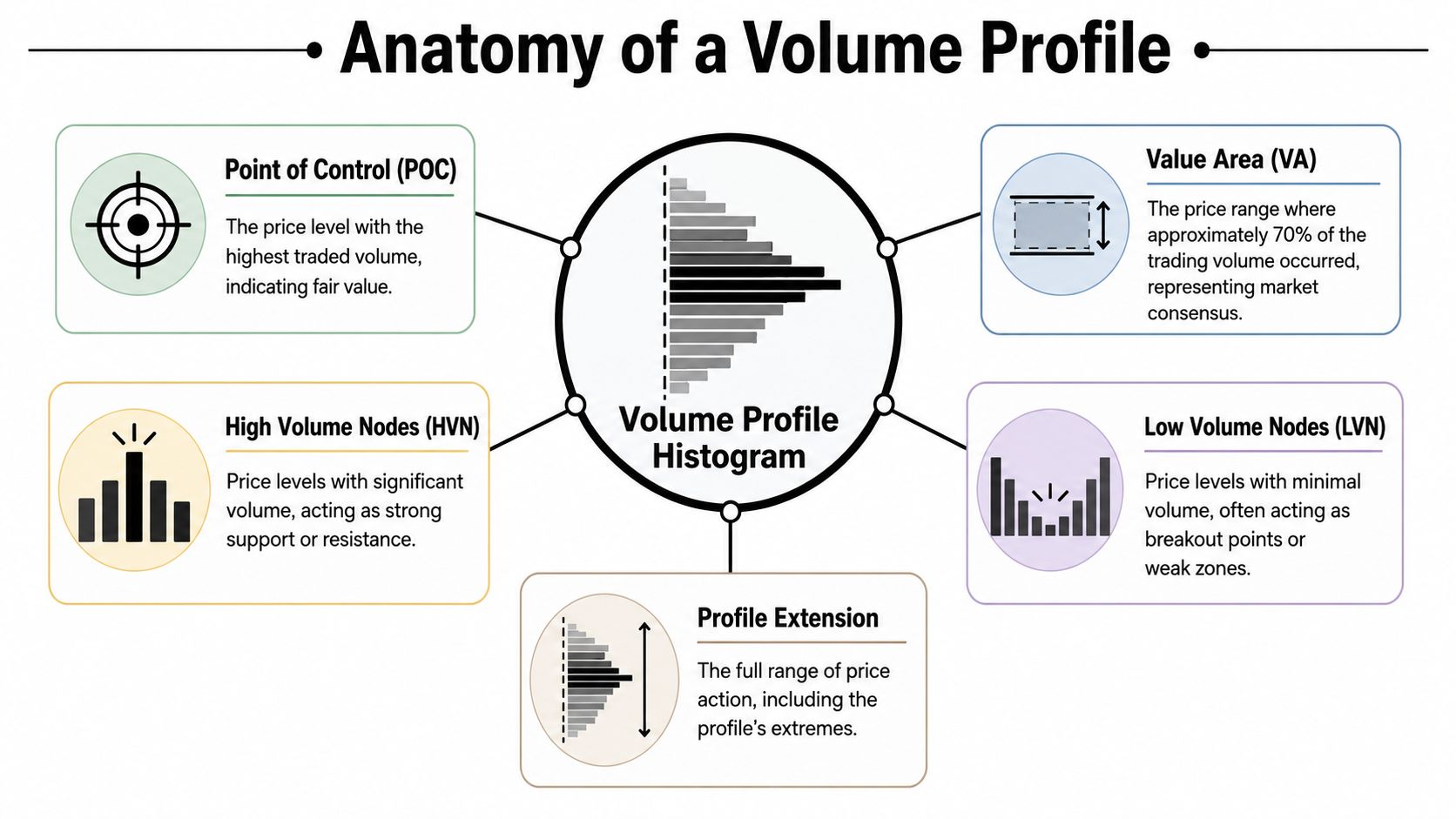
A diagram illustrating the key components of a trading volume profile, including POC, HVN, LVN, and VA.

The parts that matter most

The Point of Control, or POC, is the price with the most traded volume in the selected profile. Start there. It often acts like the market's current fair price, at least for that session or range.

The Value Area, or VA, is the price range that contains about 70% of the volume in many standard volume profile settings. Futures and market profile education commonly uses that convention, including CME's explanation of value area, value area high, and value area low in auction-based analysis. Its upper and lower boundaries are the Value Area High (VAH) and Value Area Low (VAL).

What matters in practice is simple:

  • POC marks the price that attracted the most business.
  • VAH and VAL frame the zone where the market spent most of its effort.
  • Outside value is where price is trying to establish a new area of acceptance.

That framework is useful on its own. In crypto, it gets stronger when you pair it with crypto volume analysis and then check whether wallet flows support what the profile suggests. A breakout above VAH means less if exchange inflows spike and large holders start distributing into that move.

HVN and LVN in plain language

A High Volume Node (HVN) is an area where a lot of two-way trade took place. These zones often act as magnets because market participants already did significant business there. If price returns, it usually finds interest again.

A Low Volume Node (LVN) is a thin area with much less participation. Price often moves through those zones quickly, especially in crypto where momentum traders and liquidation flows can push a market through empty pockets fast.

That difference matters more than traders expect.

If price is rotating around an HVN, fading extremes and targeting a return toward heavier trade can make sense. If price enters an LVN with strong participation, fighting the move usually costs money. The better question is whether the market is crossing that thin area to reach the next accepted zone, and whether on-chain activity supports continuation or warns that the move is being sold into.

TermAbbreviationWhat It Represents
Point of ControlPOCThe price level with the highest traded volume in the selected profile
Value AreaVAThe price range containing roughly 70% of traded volume in standard settings
Value Area HighVAHThe upper boundary of the value area
Value Area LowVALThe lower boundary of the value area
High Volume NodeHVNA price area with heavy participation and strong two-way trade
Low Volume NodeLVNA thin price area with relatively little participation

One setup every trader should understand

A common and useful read is the re-entry back into value after price opens or pushes outside it. When price quickly gets back inside the value area, that often signals failed acceptance at the new prices and raises the odds of rotation back toward the POC.

Use that setup with judgment. In a balanced session, the reversion trade is often clean. In a strong trend, fading outside value just because price touched back inside can be a trap, especially if perp funding, open interest, and aggressive spot buying are all pushing the same way.

Crypto adds one more filter. If price reclaims value and on-chain data shows accumulation, reduced exchange balances, or fresh activity from smart money wallets near the same zone, the level carries more weight. If wallets are sending coins to exchanges into that retest, treat the reclaim with more skepticism.

A strong profile read starts with a simple question. Is the market accepting these prices, or rejecting them?

Reading Market Structure with Profile Shapes

The individual levels tell you where business happened. The shape tells you what kind of market you're dealing with.

A visual landscape illustration explaining financial market phases using volume profile mountain shapes and trend directions.

Volume profile is distinct from time-based volume because it maps volume-by-price, and its common shapes, including D, P, b, and B, give traders a structured way to read balance, exhaustion, and continuation, as outlined in this overview of volume profile shapes.

The D profile

A D-shaped profile is the classic balanced auction. Volume is distributed more evenly around the center, and the market keeps rotating through accepted prices.

In that environment, the POC often matters more than breakout lines. Price tends to probe higher or lower, fail to find acceptance, and drift back toward the middle. If you're trying to force trend trades in a clean D profile, you're usually fighting the tape.

The P and b profiles

A P-shaped profile often shows up after a squeeze or sharp upward response. The market leaves a bulge higher in the distribution, which can reflect short covering and a higher-area acceptance attempt. Sometimes it leads to continuation. Sometimes it marks the late stage of an upside move.

A b-shaped profile is the mirror image. It often appears after long liquidation or heavy downside pressure. If price can't rebuild acceptance higher, that lower bulge can reflect continuing weakness.

The B profile

The B-shaped profile usually means the market is dealing with two competing areas of acceptance. Think of it as a double distribution. One zone was accepted. Then price moved, and a second accepted zone started forming elsewhere.

That matters because the thin area between those bulges can become a fast-travel path if price revisits it with conviction.

How to use shapes without overcomplicating them

I'd reduce the whole framework to three decisions:

  • Balanced shape means think rotation first.
  • Elongated or shifting shape means think discovery first.
  • Double distribution means watch the thin zone between accepted areas.

If you already use structural frameworks, this piece on market structure diagrams pairs well with profile shape analysis because the two methods solve different parts of the same problem.

The profile shape doesn't predict the future. It tells you what type of auction is developing, which is often enough to stop you from using the wrong playbook.

Building Trading Strategies with Volume Profile

A level means nothing by itself. The trade comes from what price does once it gets there, how much volume builds around it, and in crypto, whether on-chain flows support the move or argue against it.

That shift in focus changes execution.

Setup one for balanced markets

Balanced auctions usually reward patience. If price pushes into VAH or VAL, fails to hold outside value, and rotates back in, the cleaner idea is the move back toward the POC rather than a breakout chase.

The edge is not the touch. The edge is the failed auction.

What tends to work:

  • Wait for the failed move to prove itself: A quick push through value that cannot hold is different from price spending time and building volume outside the range.
  • Use the POC as the first target: In balance, that is often the most logical magnet because it marks the area where the market has already done the most business.
  • Cut the idea if acceptance starts forming elsewhere: Once the market begins building volume outside the old value area, the rotation trade loses quality.

Crypto adds one more filter here. If price rejects above value but large wallets are still accumulating on-chain into the pullback, fading that move gets riskier. If the rejection lines up with distribution from large holders or exchange inflows, the rotation setup usually has better odds.

Setup two for accepted breakouts

Breakouts above VAH or below VAL are not interesting because price crossed a line. They matter when the market starts doing business at the new prices.

That is the practical difference between rejection and acceptance. Rejection snaps back quickly. Acceptance spends time, prints volume, and holds the move. A trading guide from Jumpstart Trading explains this distinction well in its discussion of auction market acceptance and rejection.

My checklist is simple:

  1. Price leaves value
  2. It holds outside value
  3. Volume starts building at the new area
  4. The next target is the next area of prior acceptance, often an HVN

If step two fails, the breakout thesis is weak. If step three fails, I assume the move may still be a probe rather than a real shift in value.

In crypto, I want confirmation beyond the chart. A breakout from value that coincides with strong spot buying, coins leaving exchanges, or accumulation by wallets that have been right before tends to hold better. A breakout with thin follow-through, rising exchange deposits, or obvious smart money selling into strength often turns into a trap. Volume profile gives the map. On-chain activity helps confirm whether the move has committed buyers behind it.

Setup three for LVN traverses

Low Volume Nodes are travel zones. Price can move through them quickly because the market did not spend much time agreeing on value there.

That speed is the opportunity and the risk.

These trades are best when momentum is already obvious and the destination is clear. If price enters an LVN cleanly, the trade is usually for continuation into the next accepted area, not for holding and hoping inside the thin zone itself.

A few rules keep this setup disciplined:

  • Take them in directional conditions: In chop, price can poke into an LVN and reverse just as fast.
  • Avoid late entries: If the market already crossed most of the thin area, the easy part of the move is gone.
  • Target acceptance, not emptiness: The next HVN or established volume bulge makes more sense than a random price level.

On-chain context matters here too. If price is driving through an LVN while large wallets are aggressively moving coins onto exchanges, I get more cautious on upside continuation. If the move is supported by spot-led demand and no obvious distribution from larger holders, the traverse has a better chance of completing.

A simple decision table

Market conditionWhat to look forBetter trade ideaPoor trade idea
Balanced auctionFailed move outside VAH or VAL, then return into valueRotation back toward POCSelling or buying the first touch blindly
Acceptance outside valueTime and volume building above VAH or below VALContinue toward the next accepted areaFading a move that is clearly holding outside value
Thin profile zoneClean momentum into an LVN with room to travelTraverse toward the next HVNChasing after most of the LVN move is done

The practical habit is simple. Trade response, not location. In crypto, confirm that response with wallet flows and smart money behavior before sizing up.

Volume Profile in Crypto and On-Chain Analysis

Crypto breaks a lot of assumptions traders bring over from futures and equities. There's no clean close. There isn't one universally dominant session. Liquidity shifts by venue, by token, by day, and sometimes by the behavior of a small cluster of large wallets.

That's why anchored profiles in crypto can be tricky. In fragmented 24/7 markets, anchored volume profiles can be highly path-dependent, and educational material increasingly recommends combining profile levels with order-flow or on-chain confirmation because profile levels alone can mislead when liquidity is uneven, based on this reference on anchored volume profile limitations in crypto.

Here's the practical consequence. In crypto, a great-looking HVN isn't enough.

Screenshot from https://www.walletfinder.ai

What makes crypto different

In traditional session-based markets, you can often build profiles around regular trading hours and get a stable read. In crypto, your result changes much more depending on where you anchor:

  • A swing low
  • A token listing
  • A breakout candle
  • A news event
  • A major token release
  • A whale accumulation phase

All of those can produce different profiles, and each may be valid for a different question.

If you anchor badly, the profile still looks precise. That's the danger. The chart can give you a false sense of confidence because the histogram is neat, but the underlying reference period may be wrong for the move you're trading.

How on-chain data improves the read

On-chain data helps answer the question the profile can't answer by itself. Who is active at this level?

Suppose price is approaching a major HVN on a token that has been correcting. The profile says, “This is a historically active area.” Useful, but incomplete. You still don't know whether that zone is about to hold, get absorbed, or fail.

Now add wallet behavior:

  • Large profitable wallets are accumulating near that HVN
  • Smart money addresses are rotating back in after distributing higher
  • Net flows into the token improve while price revisits prior value
  • New buyers appear but aggressive sellers do not expand

That combination changes the trade from a passive chart read into an evidence-based setup.

A practical crypto workflow

This is the workflow I trust most in chaotic conditions:

  1. Build the profile around a meaningful anchor
    Use the event that changed participation. That could be a breakout, a significant turning point, major news reaction, or a structural low.

  2. Mark the accepted and thin zones
    Focus on the POC, major HVNs, LVNs, and the current value boundary.

  3. Check whether price is entering, rejecting, or accepting the zone
    Don't decide too early. Watch the reaction.

  4. Pull in on-chain context
    Look for wallet accumulation, distribution, fresh smart money entries, or exits that conflict with the chart read.

  5. Trade only when chart and chain agree
    If price is at support but smart money is unloading into it, that “support” is weaker than it looks.

In crypto, profile levels are often best treated as hypotheses. On-chain flows help confirm which hypothesis deserves capital.

A video example helps tie that together in a live-market format:

What this looks like in practice

Consider two identical charts.

Both show price revisiting a prior HVN after a fast selloff. On chart one, high-conviction wallets are stepping in, entries cluster around the accepted zone, and selling pressure from top wallets slows. On chart two, the same level is being used for exit liquidity as larger holders continue distributing.

The profile level is the same. The trade is not.

That's the bridge many traders miss. Volume profile analysis tells you where the market cared before. On-chain data helps tell you whether informed participants care now.

Common Mistakes and Advanced Volume Profile Nuances

Most volume profile mistakes come from treating it like static support and resistance with nicer graphics. That's not what it is.

An infographic titled Mastering Volume Profile detailing common mistakes and advanced nuances for market analysis trading.

A major underserved angle in volume profile work is the difference between acceptance and rejection, and between rotation days and discovery days. The same POC can act as a magnet in balanced markets, while in trend phases price may move to the next accepted zone instead of respecting the prior node, as discussed in OANDA's piece on how volume profile behaves across market conditions.

Four mistakes that cost traders money

  • Treating every level like a hard line
    HVNs and value boundaries are areas of interest, not perfect prices. If you demand exact precision from a market that auctions through zones, you'll get chopped.

  • Using the wrong anchor or lookback
    A profile built on an irrelevant window gives clean visuals and bad decisions. In crypto, this is one of the biggest hidden errors.

  • Ignoring regime
    A balanced market invites rotation. A discovery market punishes fade attempts. Same tool, different playbook.

  • Forcing trades in the middle of the profile
    The middle often offers the worst asymmetric opportunities. Edge usually comes from interaction with boundaries, thin zones, or developing acceptance.

What advanced traders do differently

They don't ask whether a profile level is “strong.” They ask strong in what condition.

A POC inside a balanced D-profile often acts like a magnet. A POC left behind during a strong directional move may barely matter until the market loses initiative. An LVN can act like a fast lane in one context and a failed continuation trap in another.

That's why rigid rules break down.

SituationBetter interpretation
Price returns to POC in balanceLikely rotation behavior
Price leaves prior value and builds trade elsewhereNew acceptance may be forming
Price tags VAH or VAL and snaps back insideBreakout attempt may be rejected
Price enters a thin LVN with convictionMarket may travel toward next accepted zone

The nuance that changes everything

The biggest upgrade in volume profile analysis isn't learning more labels. It's learning conditional logic.

Ask these questions in order:

  • Is the market balanced or discovering?
  • Is this level being accepted or rejected?
  • Is new trade clustering here, or is price just passing through?
  • What evidence would prove my read wrong quickly?

Good profile trading is less about predicting where price goes and more about identifying when the market is no longer behaving the way your setup requires.

Once you see profile levels as dynamic auction references rather than fixed barriers, your trade selection improves fast.

Turning Volume Data into Actionable Trades

Volume profile analysis gives you something most indicators don't. Context. It shows where the market agreed, where it moved too fast to do business, and where a breakout is building acceptance instead of just printing a dramatic candle.

That alone can clean up a lot of bad trades.

In crypto, though, the primary edge comes from adding one more layer. Volume profile shows the map. On-chain data shows who is moving through it. When those two line up, your read gets much stronger. When they conflict, you often avoid the trade that looked good on the chart and failed for reasons the chart couldn't explain.

That's why I'd treat profile work as a decision framework, not a standalone signal engine. Mark the accepted zones. Watch how price behaves at the boundary. Then confirm whether the wallets that matter are accumulating, distributing, or staying inactive. If you already think in order-flow terms, this is the natural extension, and this guide to cumulative volume delta is useful for sharpening that side of the process.

The traders who get the most from volume profile analysis usually do three things well. They anchor with intent. They adapt to regime. They demand confirmation before committing risk.

That's the difference between drawing a profile on a chart and trading from it in practice.


If you want to connect profile levels with real wallet behavior instead of guessing whether a zone is being accumulated or sold into, Wallet Finder.ai helps you track profitable on-chain wallets, monitor smart money entries and exits, and validate whether the price levels on your chart are backed by actual blockchain activity.